

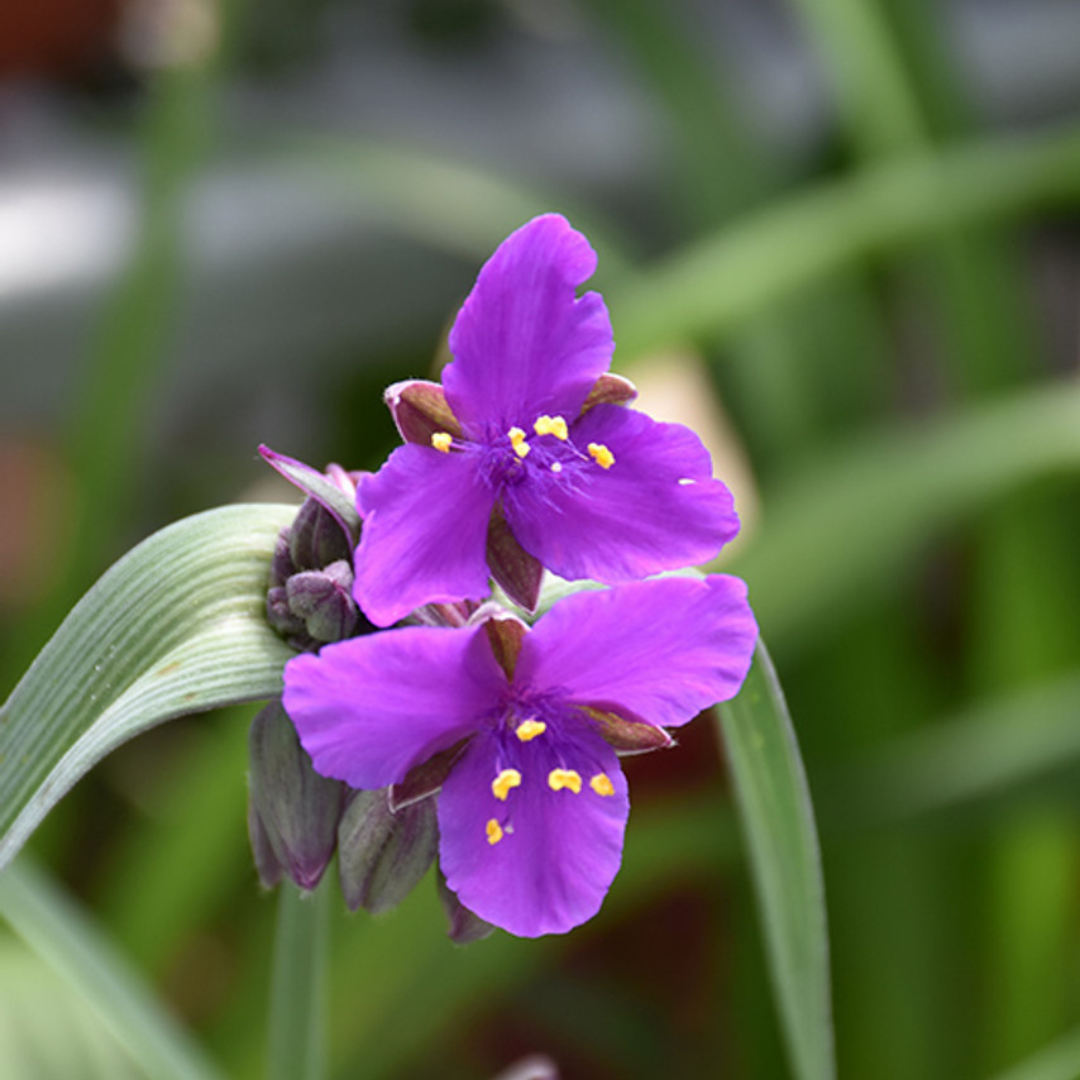
Tradescantia 'Concord Grape'
- In stock, ready for delivery
Tradescantia 'Concord Grape': Grape Soda Purple, Bottomless Refills
'Concord Grape' looks like somebody squeezed a jar of grape jelly into three-petalled flowers. Each bloom lasts just one day, then it rolls out another, and another, all summer. FRESH BATCH EVERY MORNING.
Plant Characteristics:
- Botanical Name: Tradescantia (Andersoniana Group) 'Concord Grape'
- Common Name: Spiderwort
- Height: 40–45 cm (16–18 in)
- Spread: 45–60 cm (18–24 in)
- Flowers: Rich violet-purple, three-petalled, with yellow stamens; each lasts one day
- Bloom Time: Early summer to early fall (June to September)
- Foliage: Narrow, grass-like, blue-green leaves in a compact clump
- Features: Long blooming, rabbit resistant, tolerates moist soil
Where to Plant: Use it in the middle or front of a border, in a cottage garden, or in a rain garden or along a pond edge where the soil stays moist. Its grassy blue-green leaves add texture between rounder plants.
Companion Plants: Plant 'Concord Grape' in a sunny or part-shade bed with a pink peony, golden goldenrod and rose anemones. Paeonia 'Monsieur Jules Elie' opens big pink double peonies at 90 cm in May and June. Anemone 'Curtain Call Deep Rose' adds dark rose anemones at 36 to 46 cm in August and September. Solidago 'Golden Baby' brings golden plumes at 60 to 70 cm in August and September. Miscanthus sinensis 'Adagio' rises at 120 to 150 cm with very narrow, silvery blades.
Plant Care: Plant in full sun to part sun in average to moist soil. It handles clay well and likes soil that doesn't dry out fully. In hot, dry spots, give it some afternoon shade and extra water. Flowers open in the morning and close by afternoon on hot days. That's normal. Each flower drops on its own, so no deadheading is needed. If the clump looks floppy or tired by midsummer, cut it back hard. Fresh leaves and often a second flush of flowers follow. Divide in early spring every few years.
History: 'Concord Grape' is an American selection credited to breeder Kevin Vaughn. It belongs to the Andersoniana Group, garden hybrids that most likely involve Tradescantia virginiana, T. ohiensis and T. subaspera, all native to eastern North America.
Final Thoughts: Rabbits leave it alone, bees and butterflies don't, and it's fine with damp soil. SPREAD IT THICK.