

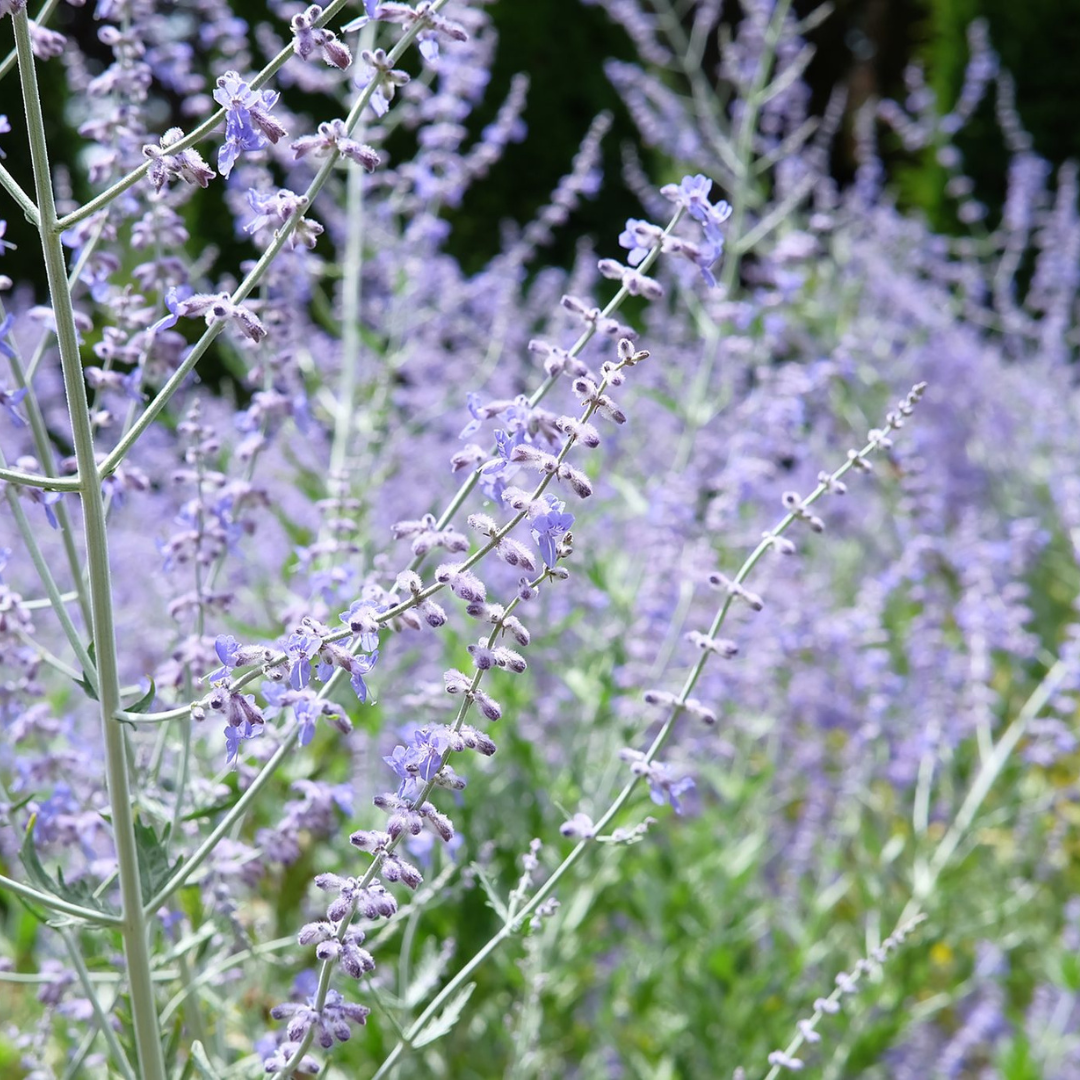
Perovskia atriplicifolia
- In stock, ready to ship
Perovskia atriplicifolia: Silvery Haze That Cools Down Hot Colours
Long, branching spikes of lavender-blue haze floating over finely cut, fragrant silvery leaves. This is the original Russian sage, the one all the compact cultivars are quietly jealous of. ACCEPT NO KNOCKOFFS.
Plant Characteristics:
- Botanical Name: Perovskia atriplicifolia (now Salvia yangii)
- Common Name: Russian Sage
- Height: 90–120 cm (3–4 ft)
- Spread: 60–90 cm (2–3 ft)
- Flowers: Tiny lavender-blue flowers on long, branching spikes
- Bloom Time: Midsummer to early fall (July to September)
- Foliage: Finely cut, grey-green to silvery, fragrant when brushed
- Features: Fragrant, Perennial Plant of the Year 1995
Where to Plant: Use it at the back of a sunny border, as a soft, see-through screen or massed on a dry slope. It does well in hot spots by driveways and south-facing walls where the ground dries out.
Companion Plants: Andropogon gerardii is a tall native grass, reaching 120 to 200 cm and flowering from August to October behind the Russian sage. Sedum 'Autumn Fire' gives pink flower heads at 45 to 60 cm from August to October. Oenothera macrocarpa brings yellow flowers at the front in June and July, before the sage peaks. This is a tough, dry-garden planting for full sun.
Plant Care: Plant in full sun in average to poor, well-drained soil, about 45 cm (18 in) from neighbours. Good drainage matters most, because the roots rot in soil that stays wet. Water through the first season, then let it handle dry spells on its own. Leave the stems standing over winter. In spring, cut them back to about 30 cm (12 in) once new growth begins. Rich soil or too much shade makes it flop, so keep it lean and sunny.
History: Russian sage grows wild in central Asia, from Afghanistan and Pakistan into Tibet, and the genus was named around 1840 by the Russian botanist Karelin for B. A. Perovski, a governor of the Russian province of Orenburg. It was the Perennial Plant of the Year in 1995, and botanists have since moved it into the sage genus as Salvia yangii.
Final Thoughts: Give it sun and a dry spot, then ignore it completely. It thrives on neglect like a cat. DEER NEED NOT APPLY.



