



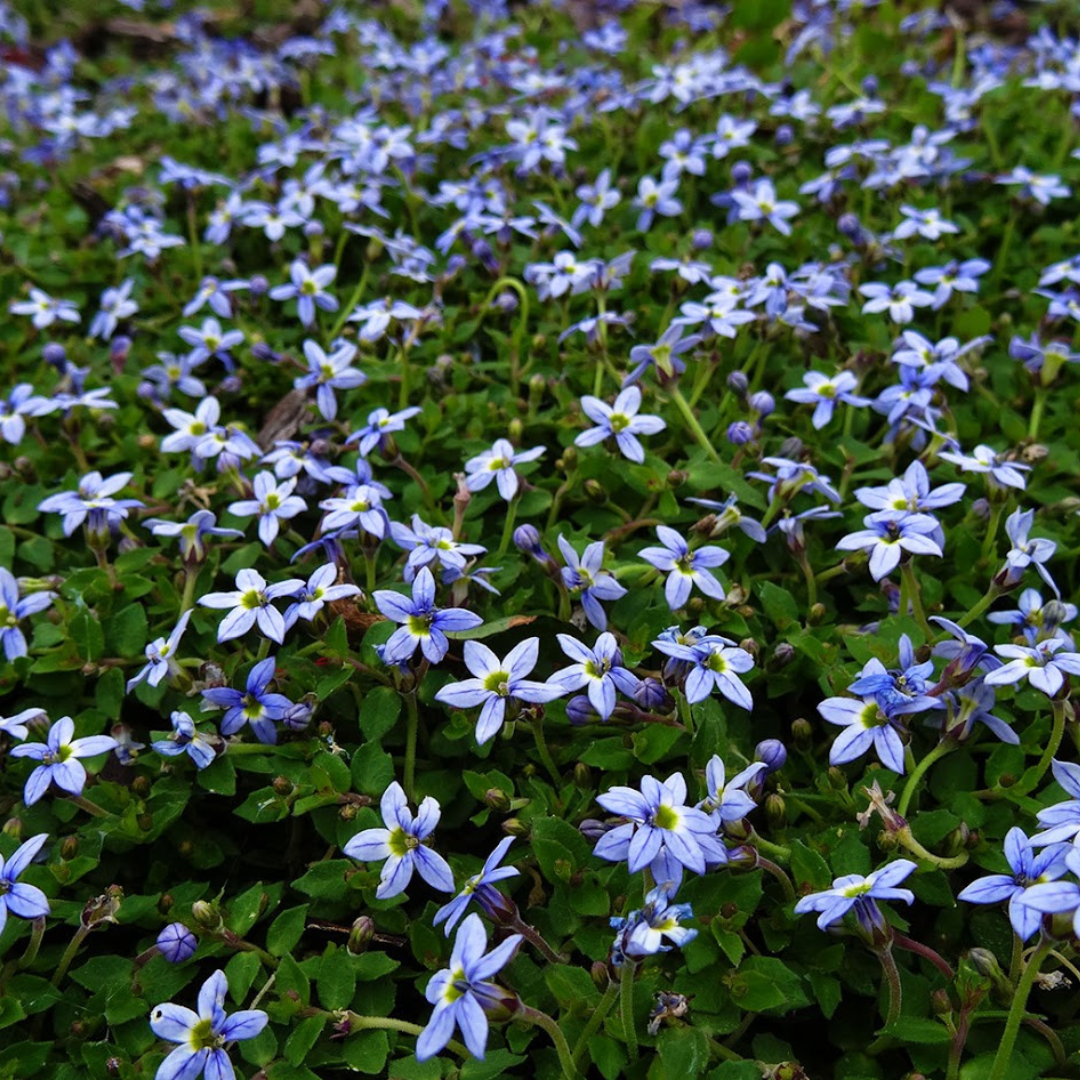
Isotoma fluviatilis
Add to Wishlist Full Sun
 Partial Sun
 Low Maintenance
- In stock, ready to ship
Isotoma fluviatilis: Tiny Blue Stars You Can Walk On
A carpet of tiny blue stars that you're actually allowed to walk on. Blue Star Creeper takes foot traffic like a hallway rug at a house party and STILL KEEPS BLOOMING.
Plant Characteristics:
- Botanical Name: Isotoma fluviatilis (syn. Laurentia fluviatilis)
- Common Name: Blue Star Creeper
- Height: 3–5 cm (1–2 in)
- Spread: 15–30 cm (6–12 in)
- Flowers: Small, light blue, star-shaped flowers about 6 mm (¼ in) across
- Bloom Time: Early summer to early fall (June to September)
- Foliage: Tiny, deep green leaves forming a dense mat
- Features: Tolerates foot traffic, creeps by rooting stems
Where to Plant: Use it between flagstones and pavers, along path edges, in rock gardens, or as a lawn substitute in small, lightly used spaces with moist but well-drained soil. It also spills softly over the rim of a container, but keep it out of the lawn if you don't want it there, because it roots as it spreads.
Companion Plants: Aubrieta 'Rock On Pink' brings pink flowers at 10 to 15 cm from April into June, before this creeper starts. Sagina subulata makes a mossy carpet at 2 to 5 cm with white flowers in May and June. Iberis 'Snowsation' adds white flowers at 15 to 20 cm in May and June. All three stay low and grow in sun to partial sun, so they mix well between stepping stones and along edges.
Plant Care: Plant in full sun to part sun in moist, well-drained soil. In hot, dry spots, a bit of afternoon shade helps. Water regularly, especially in the first season. It doesn't want to dry out completely. Hardiness is the big caveat. Reference sources rate it to zone 6, so in colder parts of Toronto, Ottawa and Montreal it may not come through winter. Choose a sheltered spot with good snow cover, or treat it as a long-blooming annual ground cover. No deadheading needed. Trim edges with shears if it wanders. Lift and replant rooted pieces in spring to fill gaps.
History: Blue star creeper is native to eastern and southeastern Australia, where it grows in damp sand and mud along streams and in wet hollows, and the species name fluviatilis means of rivers. It has also been sold as Laurentia fluviatilis and Pratia, so you may see it under several names.
Final Thoughts: Tuck it between stepping stones and let it creep. Shoes on, shoes off, IT DOESN'T CARE.



