

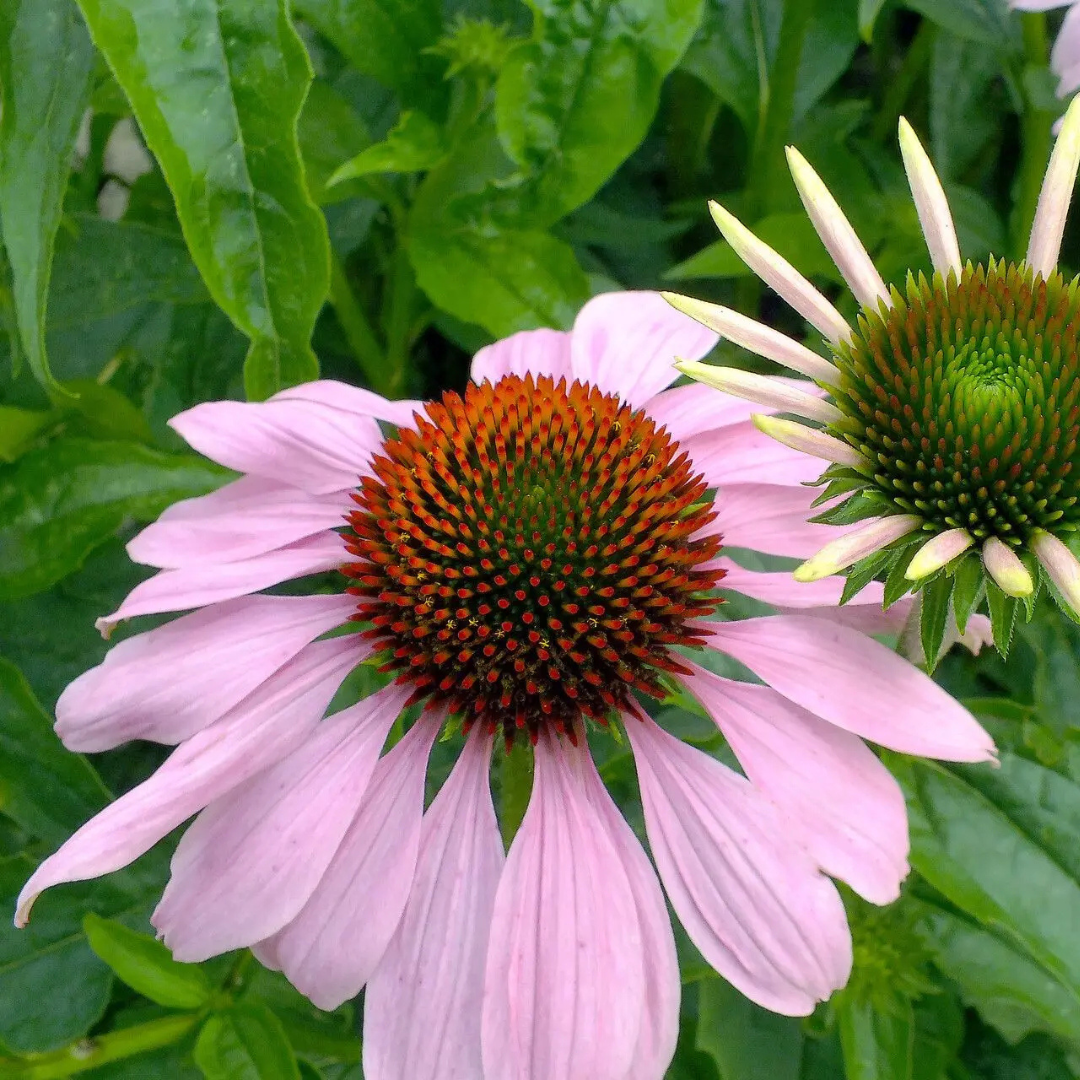
Echinacea angustifolia
- In stock, ready to ship
Echinacea angustifolia: Wild Prairie Pink for Bone-Dry Ground
Narrow, rough leaves, pale pink petals drooping like they've heard it all before, and a taproot that goes deeper than your family secrets. This coneflower laughs at drought. GRITTY, UNFUSSY AND WILDLY UNDERRATED.
Plant Characteristics:
- Botanical Name: Echinacea angustifolia
- Common Name: Narrow-leaved Purple Coneflower, Black Samson
- Height: 30–60 cm (1–2 ft)
- Spread: 30–45 cm (12–18 in)
- Flowers: Pale pink to light purple drooping petals around a spiny orange-brown cone, one flower per stem
- Bloom Time: Early to midsummer (June to July)
- Foliage: Long, narrow leaves, rough and hairy to the touch
- Features: Deep taproot
Where to Plant: This is a coneflower for dry, sunny spots: gravel gardens, sandy slopes, rock gardens and short prairie plantings. Its small size suits the front of a border, where its narrow leaves won't get lost. It needs fast-draining soil, and a rich, wet bed is the one place it won't thrive.
Companion Plants: Amsonia 'Starstruck' opens blue star flowers in May and June, just ahead of the pink coneflowers. Persicaria 'Firetail' follows from July to September with red spikes at 90 to 120 cm. Along the front, Calamintha nepeta 'Blue Cloud' forms a low, airy mound of blue from June to September. Sun or part sun suits the whole group.
Plant Care: Plant in full sun in lean, well-drained soil. Sandy or gravelly soil is ideal, and it tolerates alkaline conditions. Heavy, wet clay is a problem, so improve drainage or pick another spot. Water during the first season while the taproot develops. After that it rarely needs help. Skip fertilizer. Because of the taproot, it doesn't like being moved or divided. Leave seed heads for the birds and cut back in early spring.
History: Narrow-leaved purple coneflower grows wild on dry prairies from Saskatchewan and Manitoba south to Texas. Plains peoples used the root as a remedy for many ailments, including snakebites, burns and toothaches, and it is still one of the species used in herbal echinacea products today.
Final Thoughts: Put it in the driest, sunniest, most hopeless spot you own. THEN STOP HOVERING WITH THE HOSE.



