

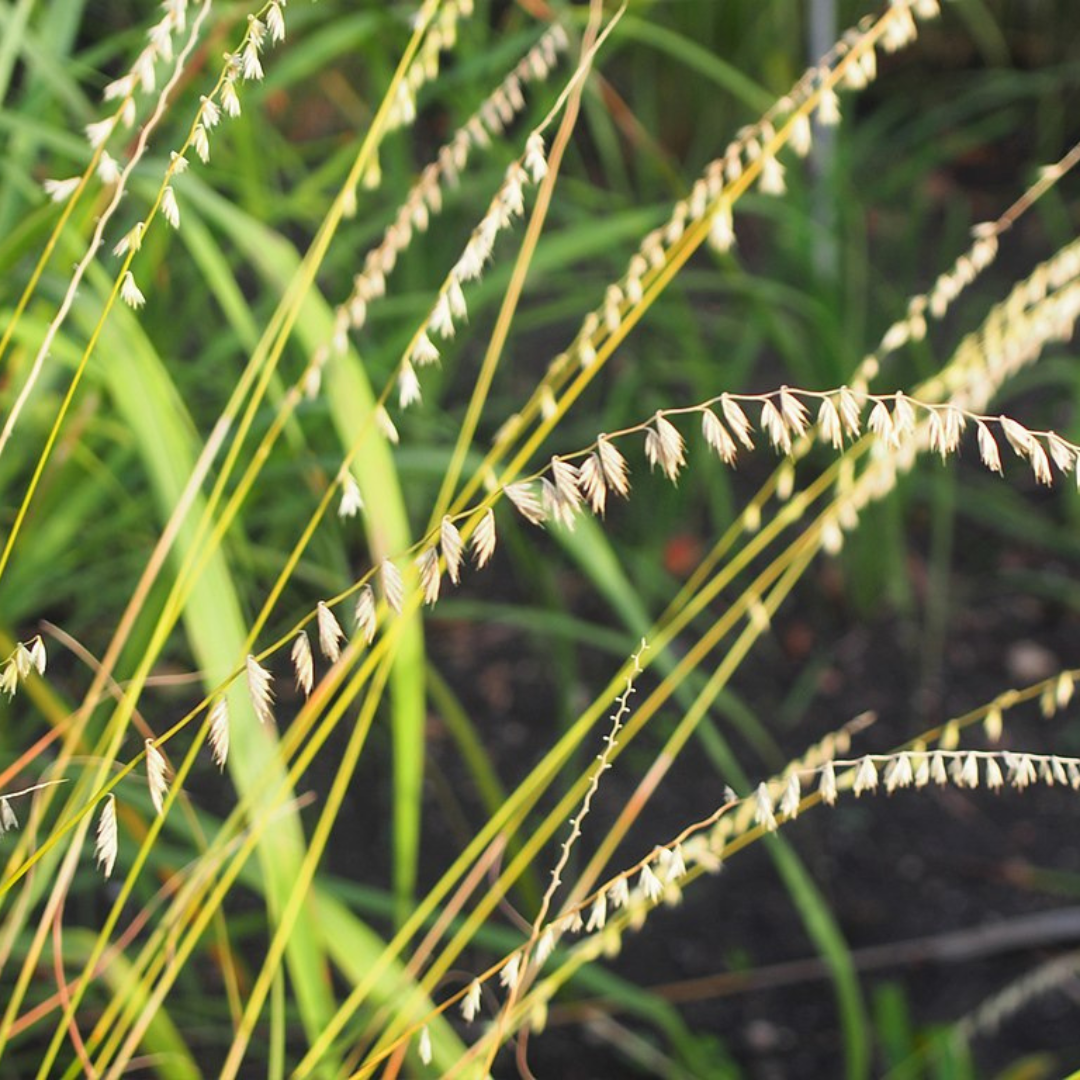
Bouteloua curtipendula
- In stock, ready to ship
Bouteloua curtipendula: Little Flags All Hung on One Side
Sideoats Grama hangs all its little oat flowers off ONE SIDE OF THE STEM, like it's mid head-tilt at your bad joke. Native, drought tolerant and perfectly happy on the dry slope you gave up on years ago.
Plant Characteristics:
- Botanical Name: Bouteloua curtipendula
- Common Name: Sideoats Grama
- Height: 60–75 cm (2–2.5 ft) in flower
- Spread: 30–60 cm (1–2 ft)
- Flowers: Small, oat-like spikelets hanging along one side of the stem, purplish to reddish at first, aging to tan
- Bloom Time: Midsummer to early fall (July to September)
- Foliage: Narrow blue-green blades turning golden tan, sometimes with purple tints, in fall
- Features: Good for erosion control, seeds for birds
Where to Plant: Sideoats grama belongs in meadows, prairie plantings, rock gardens and dry, sunny borders. It's a good choice for slopes, where its roots help hold the soil, and for the hot strip by the driveway or a sandy patch where lawn gave up long ago.
Companion Plants: Scabiosa 'Butterfly Blue' blooms blue from May to October, a long-lasting partner for this fine native grass. Liatris pycnostachya sends up purple spikes from July to September at 90 to 150 cm. At the very front, Armeria 'Alba' makes neat tufts of white flowers in May and June. All of them like full sun and lean, dry soil.
Plant Care: Plant in full sun in well-drained soil. Sandy, gravelly or average soil all work; rich or constantly wet soil makes it floppy and short-lived. Water through the first season, then only in long droughts. No fertilizer needed. Leave the clump standing over winter for texture and for birds. Cut it back to a few centimetres in early spring before new growth starts. As a warm-season grass, it greens up late, so don't panic in May. Divide in spring if the clump gets crowded.
History: Sideoats grama is native from southern Canada, including Ontario, Manitoba and Saskatchewan, through the Great Plains to Mexico and beyond, and is the state grass of Texas. The genus honours the Spanish botanists Esteban and Claudio Boutelou, and curtipendula refers to the short, hanging spikes.
Final Thoughts: Birds get the seeds, erosion gets cancelled and you get to skip the watering. LISTEN TO YOUR GRAMA.



