

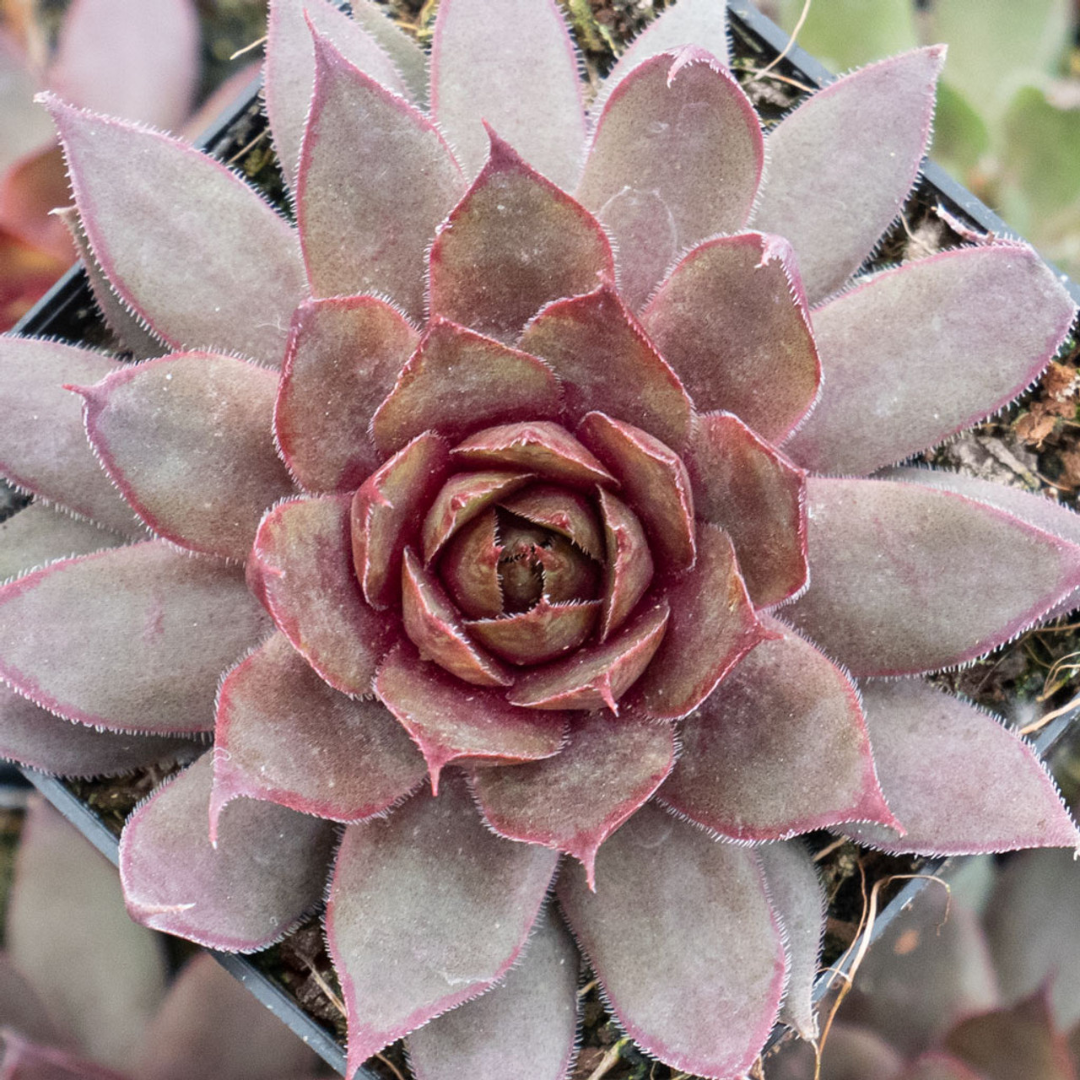
Sempervivum 'Red Beauty'
- In stock, ready for delivery
Sempervivum 'Red Beauty': Grey-Green Rosettes in Red Lipstick
'Red Beauty' gets prettier the colder it gets, like somebody walking in from the skating rink with rosy cheeks. Grey-green rosettes with red tips that blush harder when the temperature drops. WINTER LOOKS GOOD ON IT.
Plant Characteristics:
- Botanical Name: Sempervivum 'Red Beauty'
- Common Name: Hens and Chicks
- Height: 8–10 cm (3–4 in), taller when in flower
- Spread: 15–30 cm (6–12 in), widening as offsets form
- Flowers: Deep pink, starry flowers on short spikes from mature rosettes
- Bloom Time: Midsummer (July to August)
- Foliage: Evergreen, loose rosettes of grey-green leaves with red tips that intensify in cold weather
Where to Plant: Use it in rock gardens, troughs, gravel beds, stone wall pockets and shallow containers. A group of them makes a low, textured mat along a dry, sunny edge.
Companion Plants: Use 'Red Beauty' in a sunny gravel bed or wall with red catchfly, lemon yarrow and giant alliums. Silene Forged By Fire™ adds bright red stars at 38 to 45 cm in May and June. Achillea 'Moonshine' brings lemon-yellow heads at 45 to 60 cm from June to September. Allium giganteum towers at 90 to 150 cm with purple globes in May and June. Muhlenbergia capillaris adds a fine clump that turns into a pink haze in fall.
Plant Care: Plant in full sun in gritty, very well-drained soil. Heavy, wet clay and waterlogged spring soil are its main enemies. In pots, use cactus mix with good drainage. Water to settle it in, then only during long dry spells. No fertilizer needed. Cool nights and full sun bring out the strongest red. When a rosette flowers, it dies after blooming. Pull out the old rosette and stalk; the chicks will fill in. Divide offsets during the growing season.
History: 'Red Beauty' is a garden hybrid whose breeder we couldn't confirm, and its genus name, Sempervivum, means "always living" in Latin. The wild species grow in the mountains of Europe and western Asia, often on bare rock where little else can survive.
Final Thoughts: Drought, deer and neglect all bounce right off. Tuck it in a rock wall. BEAUTY SLEEP IS FOR LESSER PLANTS.