

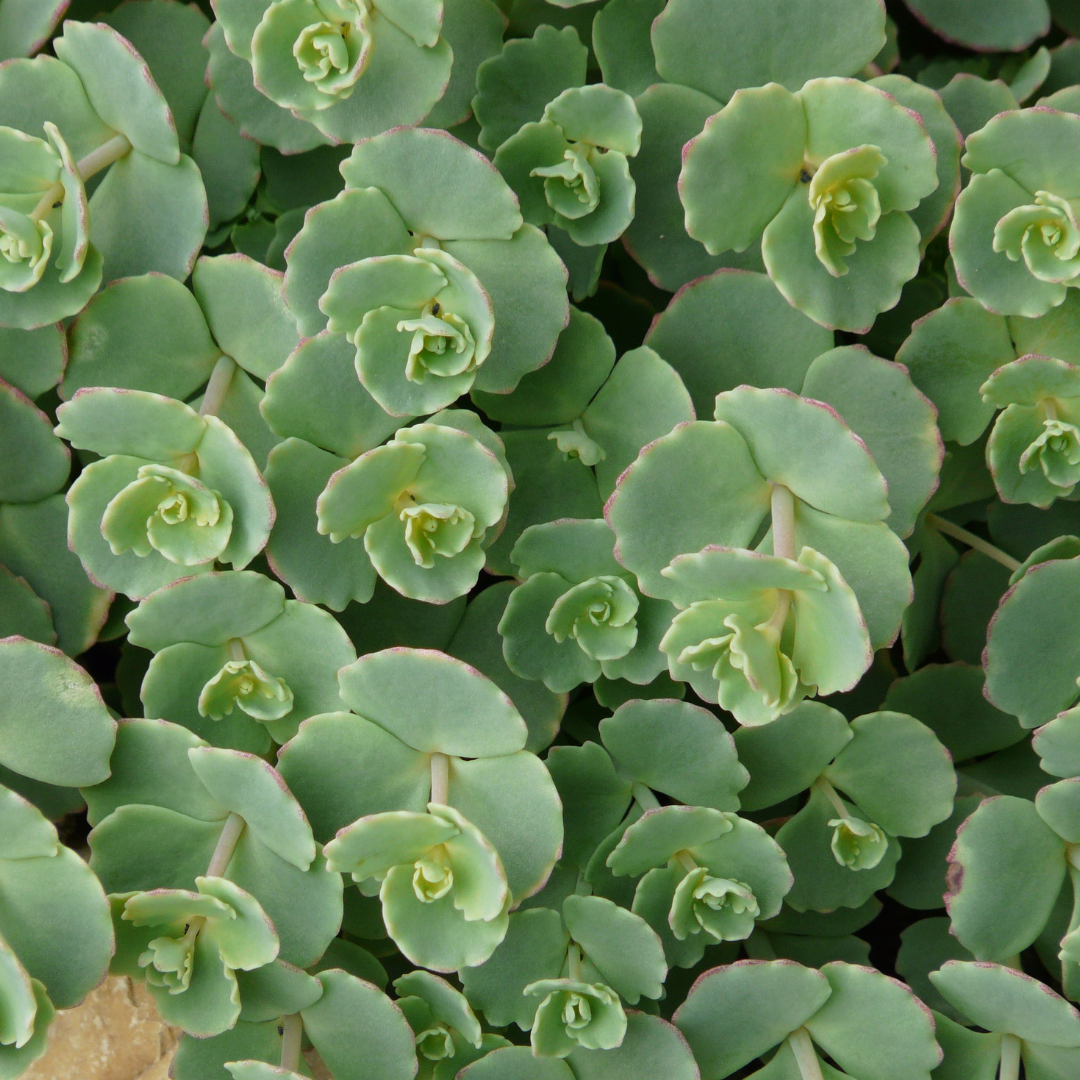
Sedum sieboldii
- In stock, ready for delivery
Sedum sieboldii: Blue Arching Stems Blushing Pink in October
This stonecrop is the fashionably late guest. Blue-green leaves edged in pink lounge around all summer, then bright pink flowers finally arrive when everybody else has gone home. WORTH THE WAIT? ABSOLUTELY.
Plant Characteristics:
- Botanical Name: Sedum sieboldii (now classified as Hylotelephium sieboldii)
- Common Name: October Daphne Stonecrop
- Height: 15–23 cm (6–9 in)
- Spread: 30–45 cm (12–18 in)
- Flowers: Small, star-shaped bright pink flowers in clusters at the stem tips
- Bloom Time: Fall (September to October)
- Foliage: Rounded, blue-green succulent leaves in whorls of three, edged pink, turning pink, orange and red in fall
Where to Plant: The arching stems look best where they can spill: the edge of a raised bed, the top of a rock wall, a trough or a container. It also suits the front of a sunny border or rock garden, where its fall colour can be seen up close.
Companion Plants: Use October daphne at the edge of a sunny, dry bed or wall, with pink phlox in spring and purple coneflowers in summer. Phlox subulata 'Drummond's Pink' carpets the front at 10 to 15 cm with hot pink flowers in May and June. Dianthus Rockin'™ Pink Magic adds white-to-pink fringed flowers at 45 to 60 cm from June to September. Echinacea purpurea brings rose-purple coneflowers at 60 to 120 cm from July to September. Elymus virginicus stands behind at 90 to 125 cm, a native wild rye.
Plant Care: Plant in full sun in loam or sandy soil with very good drainage. Too much shade gives weak, floppy stems. Wet soil, especially in winter, leads to rot, so avoid low spots and heavy clay. Water through the first season. Once established, let the soil dry out between waterings. No fertilizer needed. The stems die back in winter. Cut the old growth to the ground in late fall or early spring, before new shoots appear. Divide in spring if you want more plants.
History: This species is native to rocky outcrops and cliffs in Japan, and its name honours Philipp Franz von Siebold, the German physician and botanist who brought many Japanese plants to European gardens in the 1800s. Its common name, October daphne, points to its late bloom, not to any relation to true Daphne.
Final Thoughts: Let it spill over a pot or a wall where you can see it up close. Late pollinators will thank you. LATE BLOOMERS GET THE LAST WORD.