

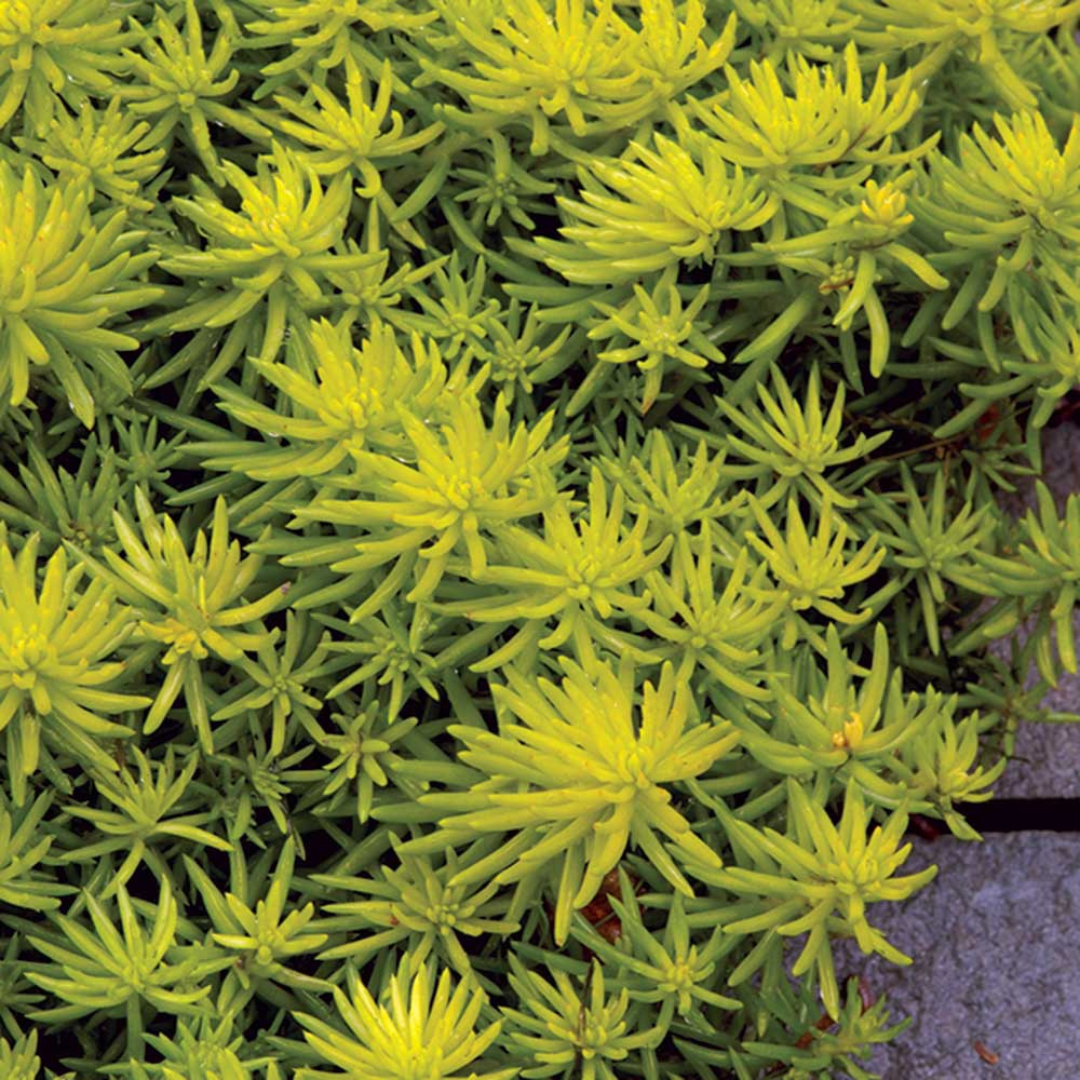
Sedum 'Angelina'
- In stock, ready for delivery
Sedum 'Angelina': Chartreuse-Gold Needles on the Move
'Angelina' looks like somebody spilled a box of gold glitter on the rock garden and refused to vacuum. Needle-thin leaves go chartreuse, then gold, then blush orange when it gets cold. HIGH MAINTENANCE LOOK. ZERO MAINTENANCE PLANT.
Plant Characteristics:
- Botanical Name: Sedum rupestre 'Angelina' (now often listed as Petrosedum rupestre)
- Common Name: Stonecrop, Angelina Stonecrop
- Height: 10–15 cm (4–6 in)
- Spread: 30–60 cm (12–24 in)
- Flowers: Small, star-shaped yellow flowers in flat clusters just above the foliage
- Bloom Time: Early to late summer (June to August)
- Foliage: Needle-like, succulent leaves that open chartreuse, turn golden yellow in sun, and pick up orange and red tints in fall and winter
- Features: Rabbit resistant
Where to Plant: Use it to edge a sunny path, spill over a retaining wall, or fill gaps in a rock garden. It's a natural for gravel gardens, green roofs, troughs and mixed containers, and it handles heat, lean soil and the dry strip along a driveway. It does not handle foot traffic, so keep it off the main walkway.
Companion Plants: Build a hot, dry gravel garden around 'Angelina', with low succulents and blue tones to set off its gold needles. Delosperma 'Jewel of Desert Ruby' carpets beside it at 10 to 15 cm with ruby-red flowers from May to September. Sempervivum arachnoideum 'Cobweb' tucks in at 5 to 10 cm with webbed rosettes. Lavandula 'SuperBlue' adds deep violet-blue spikes at 25 to 30 cm from June to August, a strong contrast to the gold. Festuca 'Elijah Blue' brings powder-blue tufts at 20 to 30 cm that stay neat all year.
Plant Care: Plant in full sun in sharply drained soil. Sandy or gritty soil is ideal. In heavy clay, add grit or plant it on a slope or raised bed, because wet winter soil is the main thing that kills sedums. Water to get it established, then only in a long drought. No feeding is needed. Rich soil makes it floppy and less colourful. It spreads at a steady pace by rooting stems. To control it, pull or snip pieces from the edges in spring. Any piece with a bit of stem will root, so share them or tuck them into bare spots.
History: Sedum rupestre, whose name means "growing on rocks", is a European stonecrop that grows wild on rocky ground across central and western Europe and into Turkey, and botanists have recently moved it to the genus Petrosedum. 'Angelina' is a gold-leaved selection and has become one of the most widely grown groundcover sedums.
Final Thoughts: Hot slope, dry crack, forgotten corner. It sparkles in all of them, and deer and rabbits pass. PLANT IT AND STOP WATERING THINGS.