

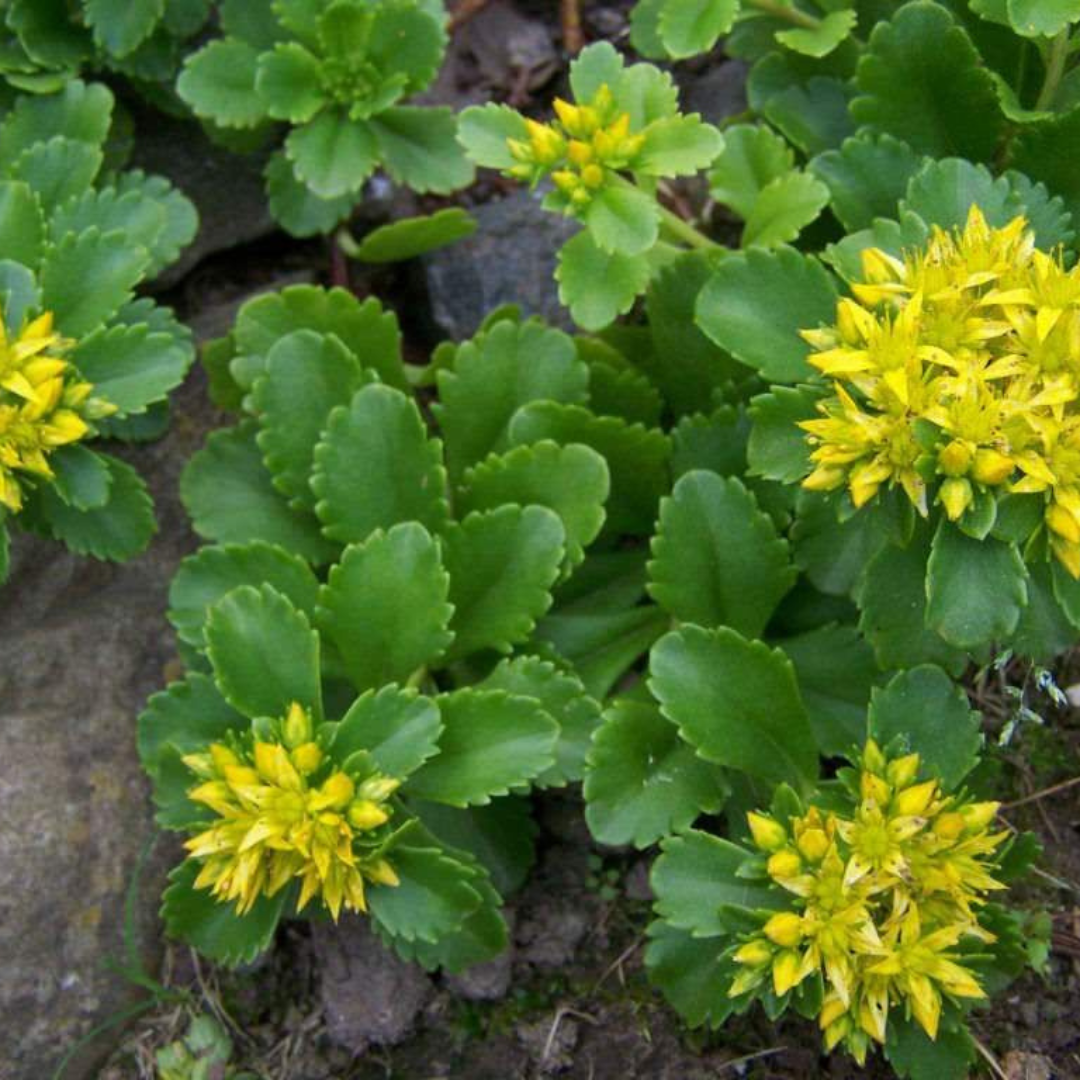
Sedum kamtschaticum
- In stock, ready for delivery
Sedum kamtschaticum: Sunny Yellow Stars for Salty Roadsides
This stonecrop is built like a snow tire. Bright green scalloped leaves, golden stars that age to russet orange, and a tolerance for neglect that borders on suspicious. WHAT'S YOUR SECRET?
Plant Characteristics:
- Botanical Name: Sedum kamtschaticum (also listed as Phedimus kamtschaticus)
- Common Name: Russian Stonecrop, also called Orange Stonecrop or Kamchatka Stonecrop
- Height: 10–15 cm (4–6 in)
- Spread: 30–40 cm (12–16 in)
- Flowers: Bright golden-yellow, star-shaped flowers in flat clusters, aging to russet orange
- Bloom Time: Early to late summer (June to August)
- Foliage: Fleshy, scalloped, bright green leaves that take on red and orange tints in fall
Where to Plant: Use it to edge a sunny path, fill a rock garden, cover a dry slope or tuck into the gaps in a stone wall. It forms a tidy mound that slowly widens into a weed-suppressing patch, and it's a classic choice for green roofs and dry containers. It's a good fit for sandy, salty or gravelly spots near the road where softer plants struggle.
Companion Plants: Use Russian stonecrop as a gold carpet in a sunny, dry bed with white pasque flowers, gold threadleaf and wine-purple pea flowers. Pulsatilla vulgaris 'Alba' opens white pasque flowers at 20 to 25 cm in April and May. Coreopsis verticillata 'Zagreb' adds golden threadleaf daisies at 30 to 46 cm from June to August. Baptisia 'Burgundy Blast' brings wine-purple spikes at 90 to 105 cm in June and July. Pennisetum 'Hameln' arches at 50 to 70 cm with soft fountain-grass plumes.
Plant Care: Plant in full sun to part sun, in well-drained soil. Sandy, gravelly or average soil is fine; heavy, wet clay is not. If you have clay, add grit or plant on a slope. Water through the first season, then only during long dry spells. Trim off old stems and spent flowers in early spring. Divide in spring or fall if the clump gets crowded, or snap off a piece with roots and replant it where you want more.
History: The species name refers to the Kamchatka Peninsula in Russia's Far East, and the plant grows wild across eastern Russia, northern China, Korea and Japan, often on rocky slopes. Botanists now often place it in the genus Phedimus, but it's still sold as Sedum, and it has been a staple of rock gardens for well over a century.
Final Thoughts: Dry banks, rock walls and that strip by the driveway everyone forgets. Bees and butterflies visit, deer don't. SET IT AND FORGET IT. SERIOUSLY.