



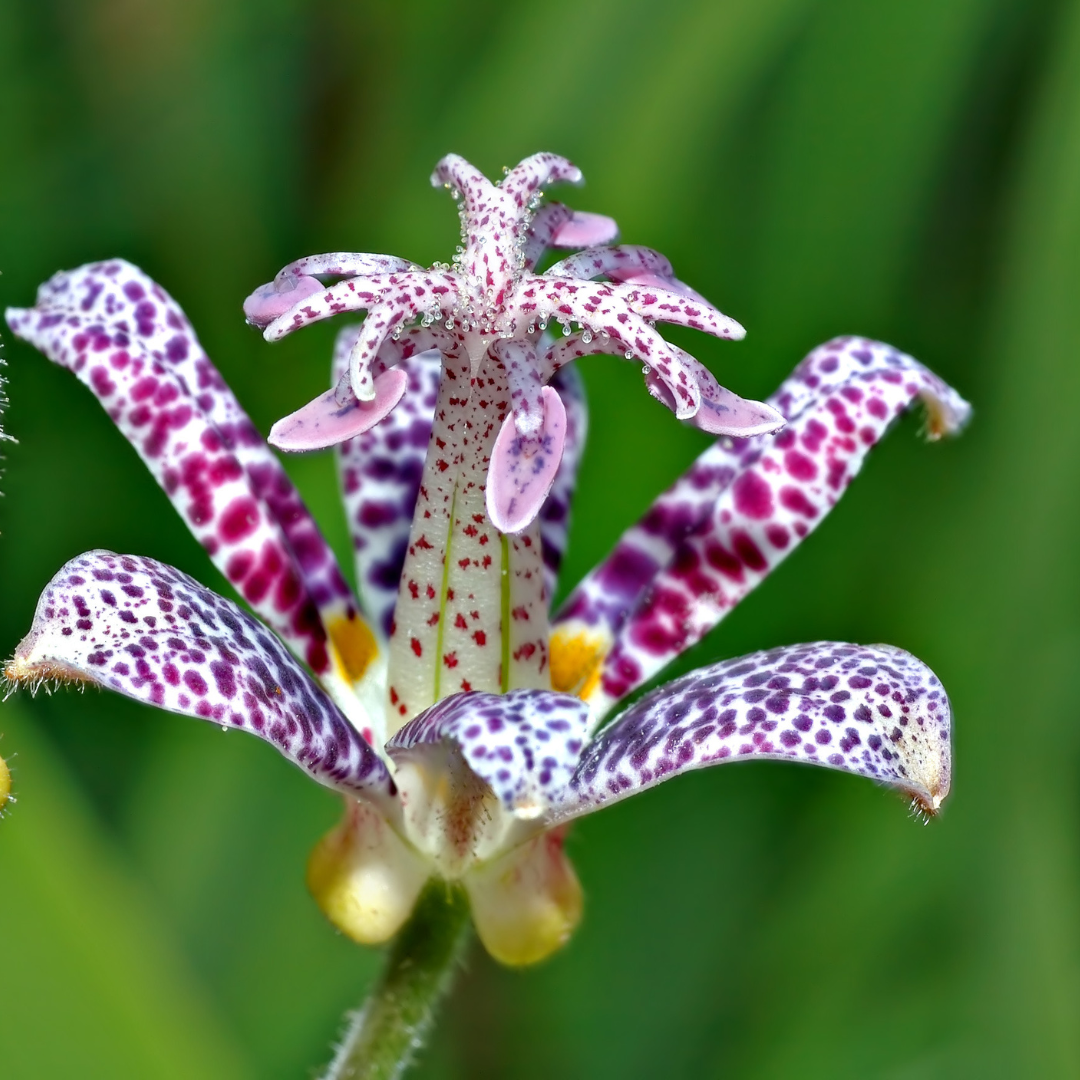
Tricyrtis hirta
Add to Wishlist Partial Sun
 Full Shade
 Deer Resistant
- In stock, ready to ship
Tricyrtis hirta: Freckled, Orchid-Like and Fashionably Late
Toad lilies have the worst name and the best freckles. Little white stars dotted with purple spots open in the shade just as everything else is going to bed. PRETTY? NO. GORGEOUS.
Plant Characteristics:
- Botanical Name: Tricyrtis hirta
- Common Name: Japanese Toad Lily
- Height: 60–90 cm (2–3 ft)
- Spread: 45–60 cm (18–24 in)
- Flowers: Small, upward-facing, star-shaped flowers about 2 cm (3/4 in) across, white to pale lilac with dense purple spots
- Bloom Time: Late summer to early fall (August to September)
- Foliage: Medium green, lance-shaped and softly hairy, clasping arching stems
- Features: Late-season flowers, tolerates moist soil
Where to Plant: Plant it where you can see the flowers up close: along a shady path, by a back door, or at the front of a woodland bed. Its arching stems look good spilling over a low wall or the edge of a raised bed, and it's happy in moist soil.
Companion Plants: Cimicifuga 'Pink Spike' sends pink spires to 120 to 150 cm from August to October, right alongside the white toad lily flowers. Ligularia 'Pandora' adds yellow daisies at 30 to 40 cm from July to September. Astilbe 'Little Vision in Pink' brings pink plumes at 35 to 40 cm in July and August. It's a late-season shade planting for full shade to partial sun.
Plant Care: Plant in part shade to full shade, in rich, moist, well-drained soil. Work in compost at planting time, and mulch to keep the roots cool. Water during dry spells, especially in the first year. Toad lilies handle damp soil better than drought. Shelter from strong afternoon sun keeps the leaves from scorching. Cut the stems down after a hard frost or in early spring. Divide in spring when the clump gets crowded. Slugs can be a problem in wet years.
History: Tricyrtis hirta is native to Japan, where it grows on shaded slopes and in moist woodland. The species name hirta means hairy, after its fuzzy leaves and stems, and the genus name comes from Greek for three humps, describing small sacs at the base of the outer petals.
Final Thoughts: Damp, shady spots and deer that won't touch it. Plant it where you'll walk past every day. KISS THE TOAD. NO PRINCE REQUIRED.



