



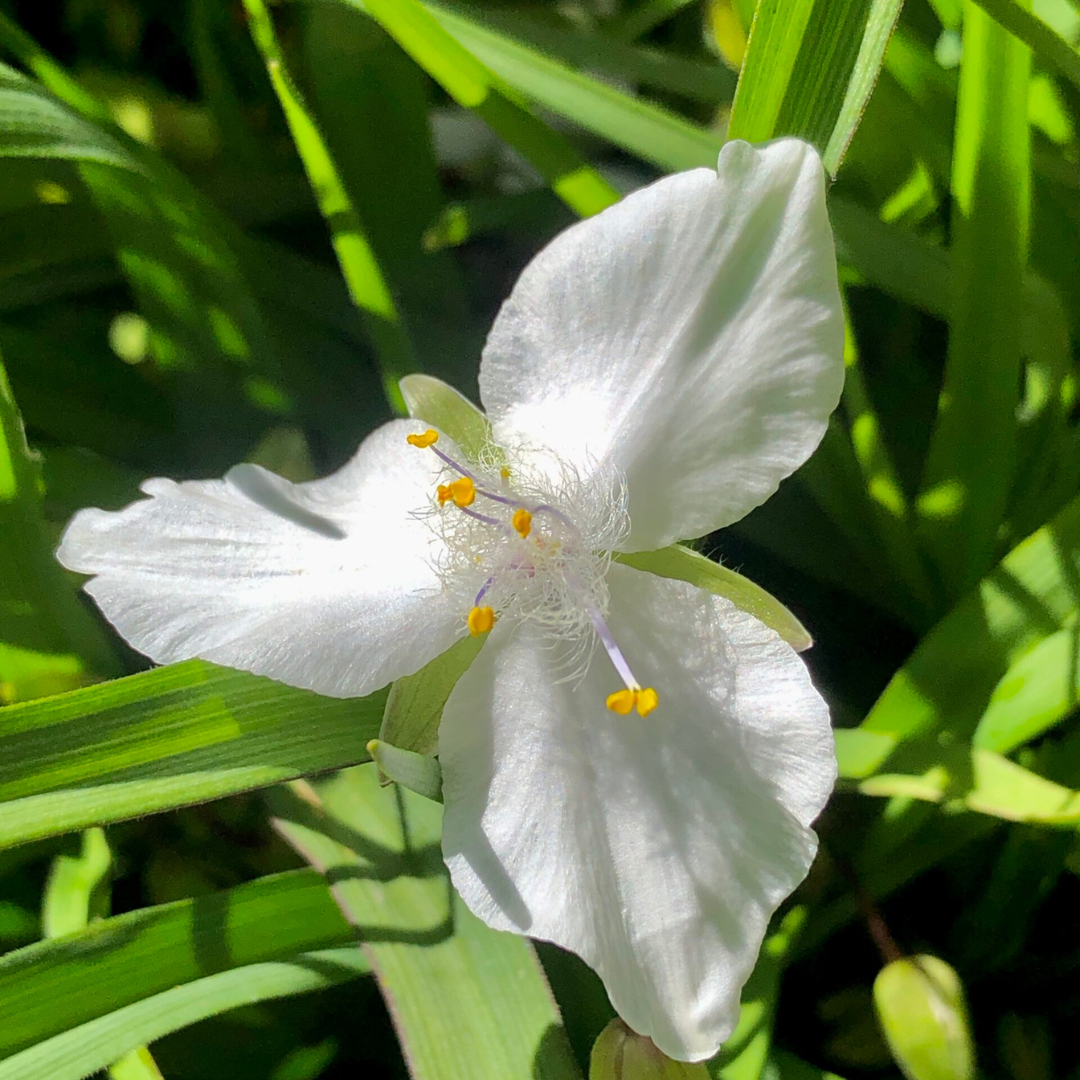
Tradescantia 'Innocence'
Add to Wishlist Full Sun
 Partial Sun
 Pollinator Friendly
- In stock, ready to ship
Tradescantia 'Innocence': Pure White Calm for a Busy Border
'Innocence' wears pure white and insists it has no idea what you're talking about. Then you lean in and notice those fuzzy stamens. ALLEGEDLY INNOCENT.
Plant Characteristics:
- Botanical Name: Tradescantia (Andersoniana Group) 'Innocence'
- Common Name: Spiderwort
- Height: 50–60 cm (20–24 in)
- Spread: 40–50 cm (16–20 in)
- Flowers: Pure white, three-petalled, with hairy stamens and yellow anthers, in clusters at the stem tips
- Bloom Time: Early summer to early fall (June to September)
- Foliage: Long, narrow, mid to dark green leaves in an upright clump
- Features: Long blooming, rabbit resistant, tolerates moist soil
Where to Plant: White flowers brighten a border edge, a cottage garden, a lightly shaded spot or a white garden that's best at dusk. It's also good for rain gardens and moist spots near ponds or downspouts.
Companion Plants: Paeonia 'Raspberry Sundae' grows to 90 cm with pink flowers in May and June, just before the white spiderwort opens. Aconitum carmichaelii 'Arendsii' adds blue spires at 120 to 150 cm from August to October, carrying the bed into fall. Geranium 'Cambridge' forms a 15 to 25 cm carpet of magenta flowers from May to July. All of these grow in full sun or partial sun.
Plant Care: Plant in full sun to part sun in average to moist soil. It handles clay. In full sun, keep the soil evenly moist so the leaves don't scorch. In deep shade, it may flower less. Flowers open in the morning and may close by afternoon on hot days. They drop on their own, so no deadheading is needed. When flowering slows and the leaves start to flop or brown in midsummer, cut the clump back to the ground. Fresh leaves follow, often with more flowers. Divide in early spring every few years.
History: 'Innocence' belongs to the Andersoniana Group, garden spiderworts long sold as Tradescantia virginiana that researchers later showed are hybrids likely also involving T. ohiensis and T. subaspera, all native to eastern North America. The group name honours botanist Edgar Anderson, who studied them.
Final Thoughts: Long blooming, happy in damp soil and ignored by rabbits. Plant it front and centre and keep a straight face. NOTHING TO SEE HERE, OFFICER.



