

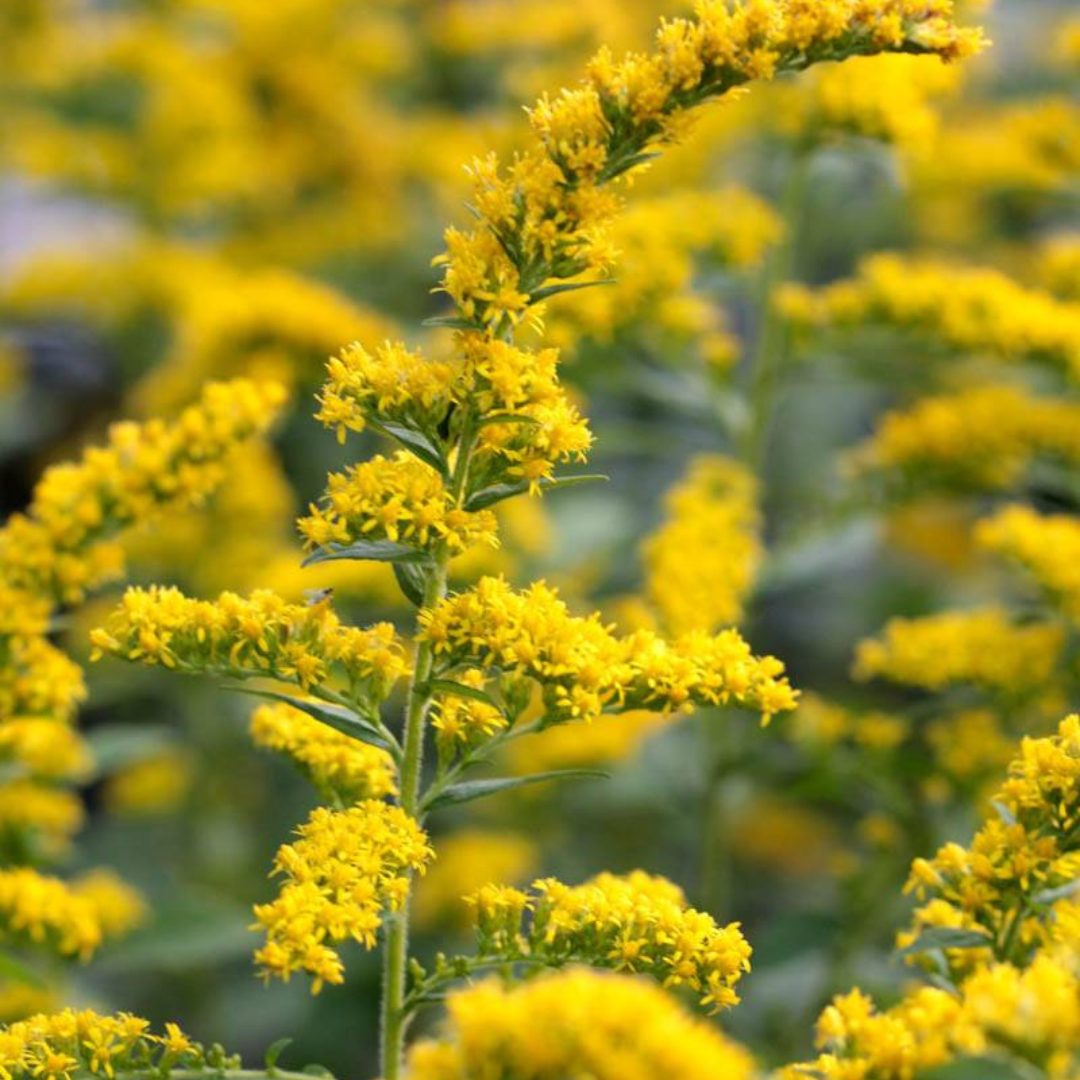
Solidago 'Fireworks'
- In stock, ready for delivery
Solidago 'Fireworks': Top-Rated Goldenrod in Arching Gold Sprays
'Fireworks' waits all summer, then launches arching golden sprays in every direction like it's Canada Day and somebody lit the whole box at once. THE BEES BROUGHT LAWN CHAIRS.
Plant Characteristics:
- Botanical Name: Solidago rugosa 'Fireworks'
- Common Name: Rough-leaved Goldenrod, Wrinkleleaf Goldenrod
- Height: 90–120 cm (3–4 ft)
- Spread: 60–90 cm (2–3 ft), slowly expanding
- Flowers: Golden-yellow, in arching sprays up to about 45 cm (18 in) long
- Bloom Time: Late summer to early fall (August to September)
- Foliage: Deep green, toothed, rough-textured leaves on sturdy upright stems
- Features: Tolerates clay
Where to Plant: Plant it in the middle or back of a sunny border, in a pollinator garden or in a naturalistic meadow planting, where it makes a strong late-season focal point. It tolerates clay and also earns a spot in a cut-flower bed.
Companion Plants: Use 'Fireworks' in a sunny or part-shade bed with an Itoh peony, lemon daylilies and big gold daisies. Paeonia 'First Arrival' opens lavender-pink Itoh peonies at 60 to 75 cm in May and June. Hemerocallis Happy Ever Appster™ 'Happy Returns' adds lemon-yellow daylilies at 40 to 45 cm from June to September. Rudbeckia 'Indian Summer' brings very large golden daisies at 80 to 90 cm from July to October. Festuca Beyond Blue™ edges the front with intense blue tufts at 23 to 30 cm.
Plant Care: Plant in average garden soil, including clay, in full sun or a spot with a few hours of shade. It prefers well-drained soil with regular moisture, but handles dry periods once it's established. Skip heavy fertilizer, which makes stems lanky. The stems are sturdy and rarely need staking. Leave the seed heads for winter birds and cut the stems down in late fall or early spring. 'Fireworks' spreads slowly by rhizomes and stays in a clump, far better behaved than wild Canada goldenrod. Divide in early spring every few years if it gets crowded.
History: 'Fireworks' was introduced in 1993 by the North Carolina Botanical Garden, selected from a coastal plain population of Solidago rugosa, a species native across eastern North America, including Ontario and Quebec. In a five-year goldenrod trial at the Chicago Botanic Garden that wrapped up in 2001, it was the top-rated plant among 22 species and cultivars.
Final Thoughts: It handles clay and deer and puts on a show when the summer border is fizzling. NO PERMIT REQUIRED FOR THIS DISPLAY.