



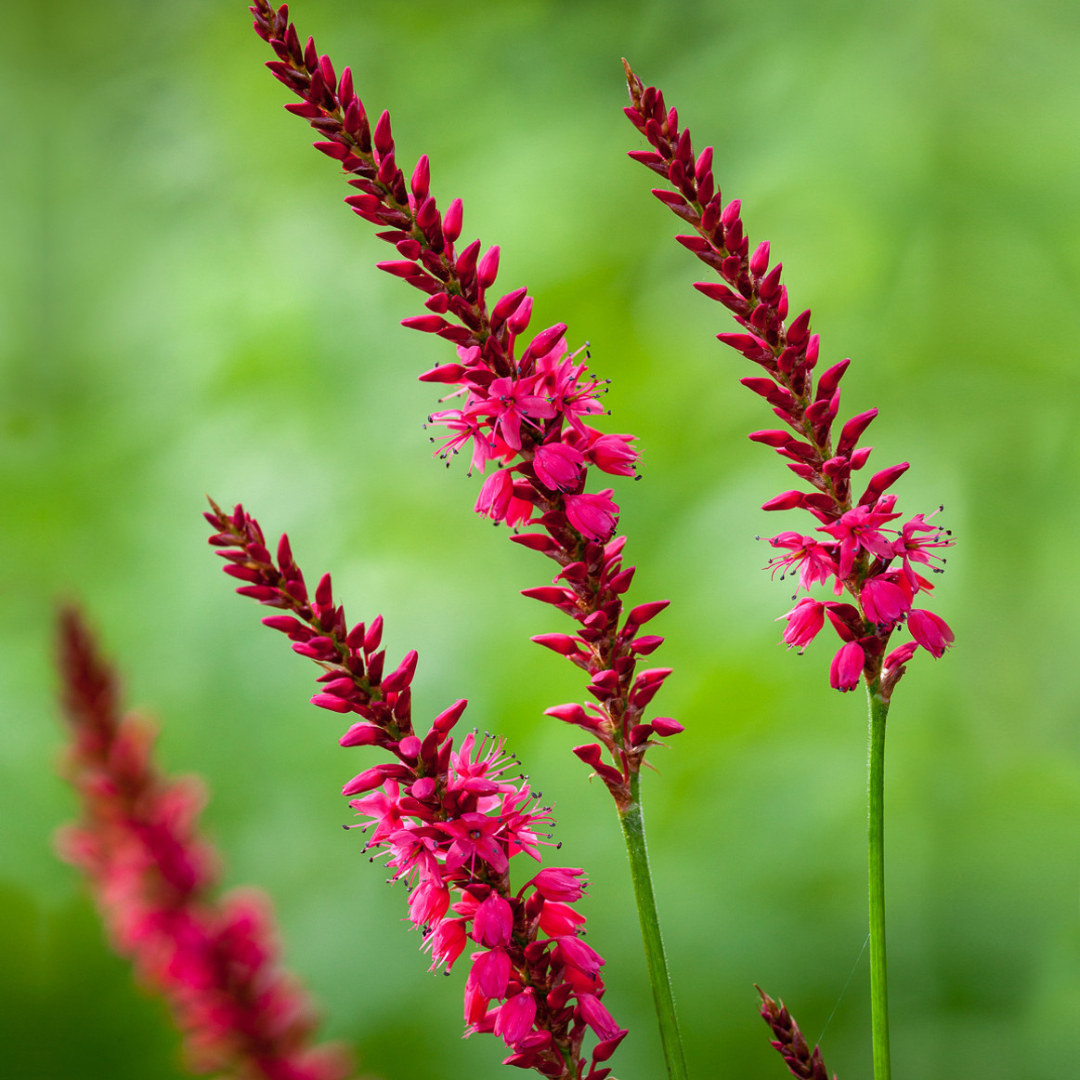
Persicaria 'Firetail'
Add to Wishlist Full Sun
 Partial Sun
 Deer Resistant
 Pollinator Friendly
 Low Maintenance
- In stock, ready to ship
Persicaria 'Firetail': Crimson Spikes Happy in Damp Ground
Slender crimson spikes start in midsummer and keep firing until frost like this plant lost the off switch. 'Firetail' is THE GUEST WHO HELPS WITH THE DISHES AND STILL WON'T LEAVE.
Plant Characteristics:
- Botanical Name: Persicaria amplexicaulis 'Firetail' (also listed as Bistorta amplexicaulis)
- Common Name: Mountain Fleeceflower
- Height: 90–120 cm (3–4 ft)
- Spread: 90–120 cm (3–4 ft)
- Flowers: Slender, crimson-red, bottlebrush-like spikes held above the leaves
- Bloom Time: Midsummer to fall (July to September), often carrying on until frost
- Foliage: Large, deep green, slightly leathery leaves forming a dense, bushy clump
- Features: Long blooming, rabbit resistant, good for cutting
Where to Plant: Give it room in the middle or back of a border, where its size reads as a feature. It's a natural fit for naturalistic and prairie-style plantings, handles damp spots near ponds or along a downspout, and earns a place in a cutting bed.
Companion Plants: Eupatorium 'Atropurpureum' towers behind at 150 to 210 cm with pink flower heads from August to October. Aster 'Wood's Light Blue' adds a low wave of blue asters over the same weeks. Sedum Puff Pastry™ White Chocolate brings cream flower heads at 30 to 35 cm from August to October. With the red spikes of 'Firetail' in the middle, this planting peaks in late summer and fall.
Plant Care: Plant in full sun to part shade, in average to moist soil. It tolerates clay and appreciates steady moisture, so water during dry spells, especially in its first summer. In a very hot, dry spot, a little afternoon shade helps the leaves stay fresh. It forms a slowly expanding clump rather than running around the garden. Cut it back to the ground in late fall or early spring. Divide in early spring every few years if it outgrows its spot.
History: Mountain fleeceflower is native to the Himalayas, from Afghanistan and Pakistan east into China, and its name amplexicaulis means "stem-clasping," after the way the leaves wrap the stems. It was long a staple of European gardens before catching on in North America, and 'Firetail' is one of its most widely grown red forms.
Final Thoughts: Bees and butterflies love it, deer and rabbits don't. Cut stems for the vase and watch it make more. YOUR LONGEST-RUNNING SHOW.



