



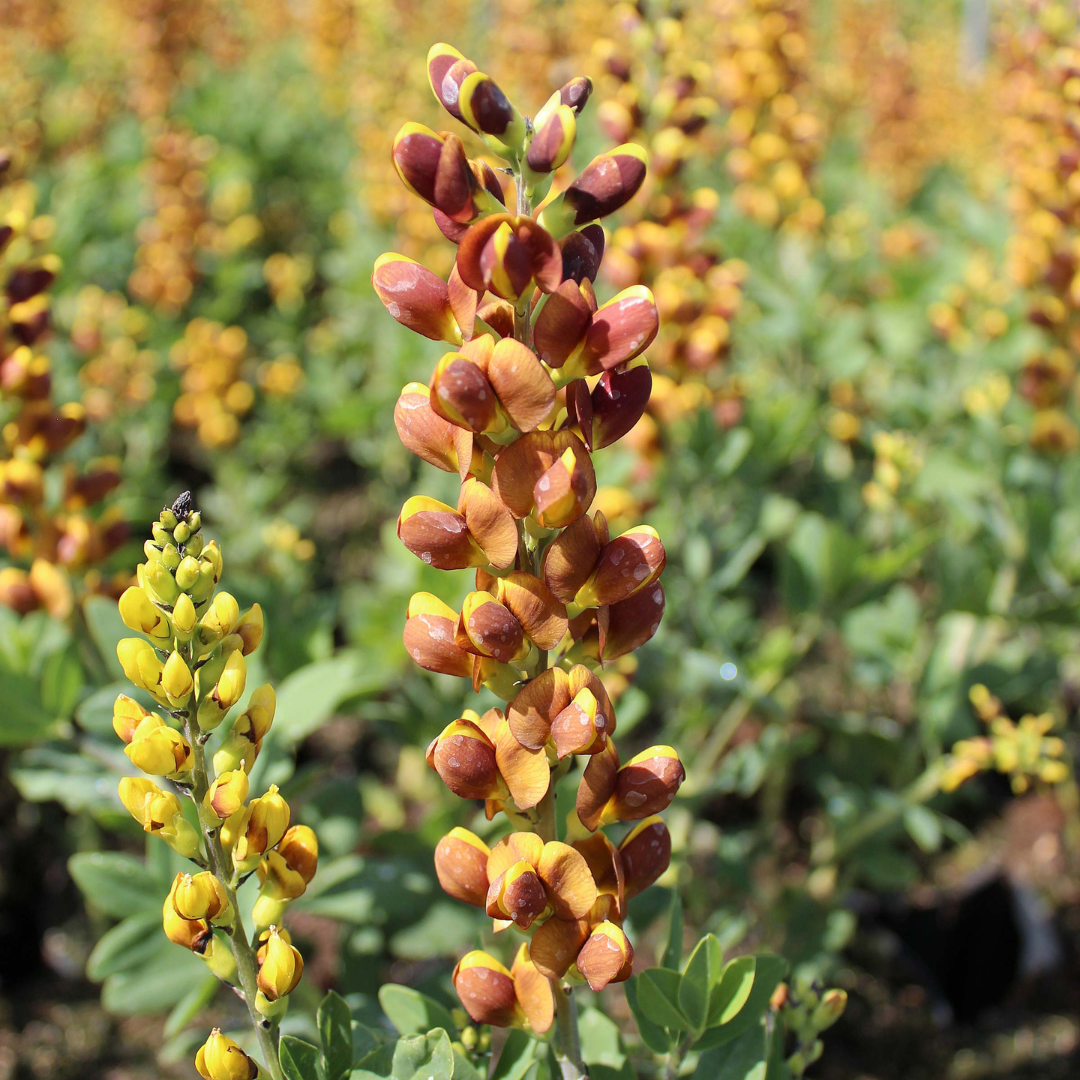
Baptisia 'Honey Roasted'
Add to Wishlist Full Sun
 Partial Sun
 Drought Tolerant
 Deer Resistant
 Pollinator Friendly
- In stock, ready to ship
Baptisia 'Honey Roasted': Mahogany Spikes Toasted to Gold
Mahogany flowers with bright yellow keels that turn golden as they age. 'Honey Roasted' looks like the snack aisle and the bar menu had a baby. THE BEES ARE ALREADY SNACKING.
Plant Characteristics:
- Botanical Name: Baptisia hybrid
- Common Name: False Indigo
- Height: 90–105 cm (3–3.5 ft)
- Spread: 105–120 cm (3.5–4 ft)
- Flowers: Dark mahogany with a bright yellow keel, lightening to yellow as they mature, for a two-tone effect
- Bloom Time: Late spring to early summer (June to July)
- Foliage: Blue-green on silvery stems, forming a broad, bushy clump
- Plant Patent: USPP 34,707
Where to Plant: It's wider than it is tall, so give it room in the middle of a sunny border or use it as a low, shrub-like anchor. It tolerates lean, dry soil and decent clay. Seed pods follow the flowers and stay interesting into fall.
Companion Plants: Tradescantia 'Concord Grape' adds purple flowers from June to September, a rich contrast to the honey tones. Geum TEMPO™ 'Orange' blooms from April to June, warming up the front of the bed before the indigo opens. For fine texture, Elymus canadensis brings arching native grass to 90 to 150 cm. It is a relaxed, prairie-style group for sun to part sun.
Plant Care: Plant in full sun to part sun, in average to poor, well-drained soil. No fertilizer is needed. Water regularly through the first season, then only during long dry spells. Like all Baptisia, it grows a deep taproot and may take two or three years to fill out. It doesn't like being moved or divided, so plant it where it can stay. Leave spent flowers to form seed pods. Cut the stems back in late fall, or leave them for winter interest and cut them in early spring.
History: 'Honey Roasted' was bred by Hans Hansen in Waseca, Minnesota, from an unreleased hybrid called 'Candy' crossed with Decadence® 'Blueberry Sundae', then selected and introduced by Walters Gardens in Zeeland, Michigan. The genus name comes from the Greek bapto, "to dip", a reference to the dye once made from some species.
Final Thoughts: Set it out in the sun next to something blue and let the two-tone show run. SERVED WARM, NEVER STALE.



