



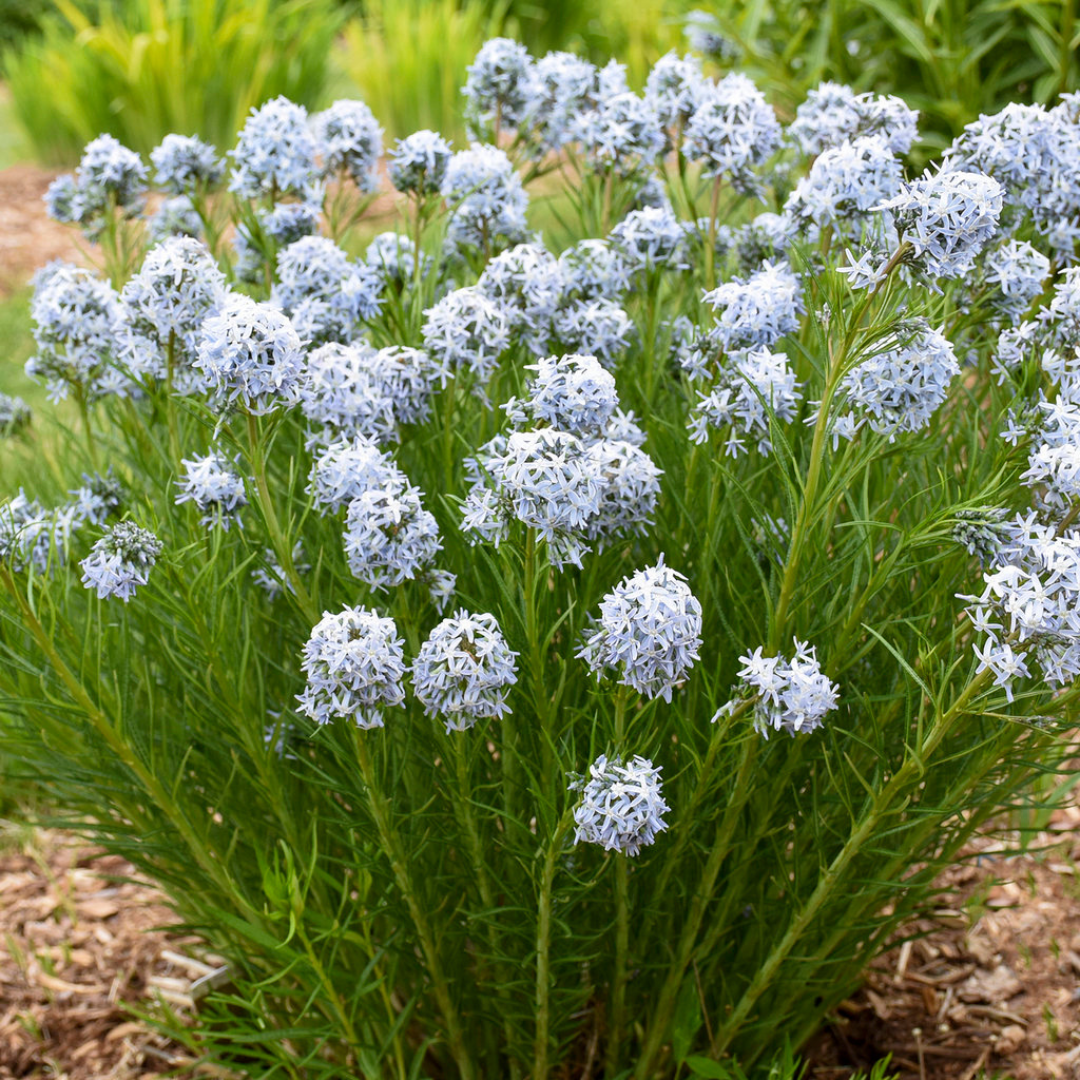
Amsonia 'String Theory'
Add to Wishlist Full Sun
 Partial Sun
 Deer Resistant
 Pollinator Friendly
 Low Maintenance
- In stock, ready to ship
Amsonia 'String Theory': Feathery Texture That Fits Small Gardens
Dark green leaves so thin they look like threads, turning golden orange in fall. 'String Theory' is the one plant in the garden smarter than the people who planted it. NOBODY UNDERSTANDS IT. EVERYBODY LOVES IT.
Plant Characteristics:
- Botanical Name: Amsonia hybrid (a compact selection from A. hubrichtii)
- Common Name: Blue Star
- Series: A Proven Winners® perennial
- Height: 61–76 cm (2–2.5 ft)
- Spread: 81–91 cm (32–36 in)
- Flowers: Clusters of light periwinkle-blue, star-shaped flowers
- Bloom Time: Late spring to early summer (June)
- Foliage: Dark green, thread-like leaves that turn golden orange in fall
- Features: Heat and humidity tolerant
- Plant Patent: USPP 34,419 / Can 7,321
Where to Plant: It brings a feathery, fine texture to smaller gardens and the front or middle of a border. Mass it for a soft, billowing effect, or use it as a low, shrub-like hedge along a path.
Companion Plants: Geranium 'Biokovo' makes a low white carpet in front from May to July, right as the blue stars open in June. Malva sylvestris 'Zebrina' grows up to 120 cm with striped pink flowers from June to September. Spigelia 'Ragin Cajun' adds red flowers at 50 cm from May to July, a bright contrast to the soft blue. All three grow in full sun or partial sun.
Plant Care: Plant in full sun to part sun in average, well-drained soil. Full sun gives the strongest fall colour and the tidiest habit. Water regularly the first year, then mainly during long dry spells. No deadheading needed. If you want to keep it compact, shear it back by about a third after flowering. Cut it to the ground in late fall, or enjoy the fall foliage and cut it back in early spring. It's long-lived and rarely needs dividing. Wear gloves when trimming, since the milky sap can irritate skin.
History: 'String Theory' was bred by Hans Hansen at Walters Gardens in Zeeland, Michigan, from a 2014 self-pollination of an unreleased Amsonia hubrichtii selection, and was introduced through Proven Winners® as a more compact threadleaf partner to 'Storm Cloud'. Walters Gardens lists it as Proven Winners® 2028 National Landscape Perennial of the Year.
Final Thoughts: Pale blue stars in spring, glowing fireworks in fall and very little work in between. The deer can't solve it. DO THE MATH AND BUY TWO.



