

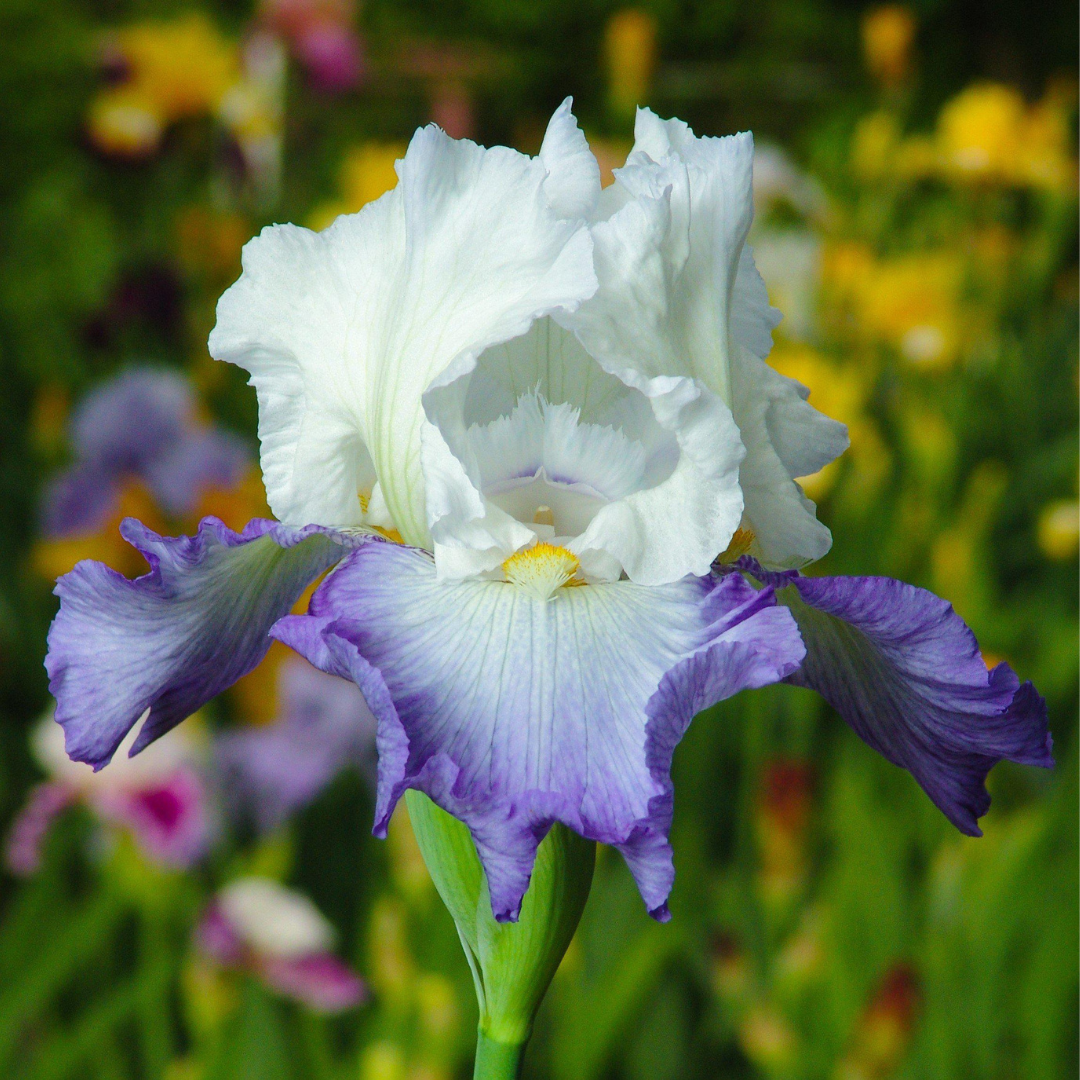
Iris 'Clarence'
- In stock, ready for delivery
Iris 'Clarence': Blue-Violet Blooms Back Again by Fall
Pale blue and white flowers that smell sweet, and then the twist: 'Clarence' comes back for A SECOND ROUND later in the year. The houseguest you actually want to see again.
Plant Characteristics:
- Botanical Name: Iris germanica 'Clarence' (tall bearded iris)
- Common Name: Bearded Iris
- Height: 75–90 cm (30–35 in)
- Spread: 45–60 cm (18–24 in)
- Flowers: Fragrant blue and white bicolour. Pale standards tinted violet, light blue-violet falls and creamy beards, with several buds per stem.
- Bloom Time: Late spring to early summer (June), often reblooming in late summer to fall (September)
- Foliage: Blue-green, sword-shaped leaves in upright fans
- Features: Reblooming, fragrant
Where to Plant: Plant it in a sunny border, a cottage garden or a cutting bed, near a path or patio so you catch the scent. Bearded irises dislike wet clay, so in heavy soils plant it on a slope or in a raised bed where water drains away quickly.
Companion Plants: Give reblooming 'Clarence' a sunny, well-drained bed with orange coneflowers and tall yellow hollyhocks. Delosperma 'Jewel of Desert Topaz' carpets the front at 10 to 15 cm with yellow-orange flowers from May to September. Echinacea SunMagic® Vintage Electric Orange adds intense orange coneflowers at 45 to 60 cm from July to September. Alcea 'Sunshine' rises at the back to 150 to 180 cm with yellow hollyhocks from July to September. Pennisetum 'Little Bunny' fills in at 25 to 40 cm with tiny, fluffy plumes.
Plant Care: Plant the rhizome so its top sits right at the soil surface, with the roots spread out below. Bearded irises rot when buried or mulched over, so keep mulch away from the rhizome. Water through the first season, then only during long dry spells. Rebloomers do best with a little extra help. After the first flush, give it a light feeding with a low-nitrogen fertilizer and water during dry weeks in summer. Cut finished flower stalks down to the base. In fall, remove dead leaves and debris to reduce places for iris borer eggs to overwinter. Divide crowded clumps every three to five years, in July or August after bloom.
History: 'Clarence' was registered in 1991 by Lloyd Zurbrigg, whose interest in irises began in Listowel, Ontario, and who became known for rebloomers suited to short northern seasons. It won the American Iris Society's Wister Medal, its top award for tall bearded irises, in 2000.
Final Thoughts: Full sun, a little neglect and a nose nearby, and the deer leave it be. ENCORE, CLARENCE, ENCORE!