

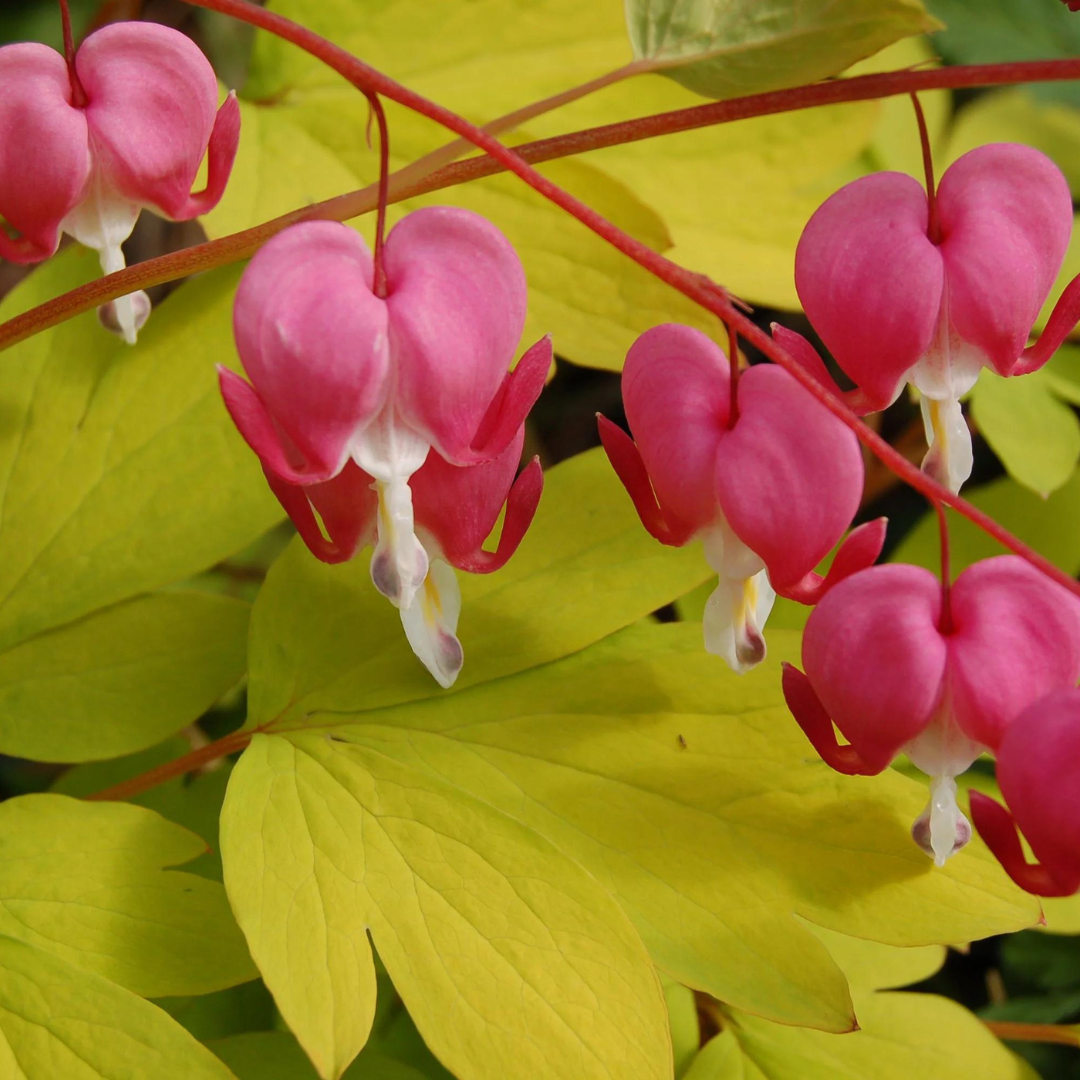
Dicentra 'Gold Heart'
- In stock, ready for delivery
Dicentra 'Gold Heart': Pink Lockets Over Golden Leaves
Bright gold leaves, red stems and rose-pink hearts. On paper it shouldn't work. In the shade, 'Gold Heart' pulls it off like somebody who wears clashing colours on purpose and LOOKS BETTER THAN YOU.
Plant Characteristics:
- Botanical Name: Lamprocapnos spectabilis 'Gold Heart' (formerly Dicentra spectabilis)
- Common Name: Gold-leaved Bleeding Heart
- Height: 60–75 cm (2–2.5 ft)
- Spread: 60–75 cm (2–2.5 ft)
- Flowers: Rose-pink hearts with small white inner petals, hanging from arching stems
- Bloom Time: Late spring to early summer (May to June)
- Foliage: Bright golden-yellow, deeply divided, on red-tinted stems. It may go dormant in summer heat.
- Features: Colourful foliage
Where to Plant: Plant it where you need a bright spot in shade, such as under trees, along a woodland path, or by a north-facing wall. It can fade by midsummer, so leave room for later neighbours to spread into the space.
Companion Plants: Plant 'Gold Heart' in a moist, shady bed where its gold leaves and pink hearts sit over dark partners. Helleborus HGC® Ice N' Roses® Carlotta opens deep red flowers at 30 to 50 cm from March to May. Tiarella 'Pink Skyrocket' adds shrimp-pink spikes at 15 cm in foliage in May and June. Astilbe Mighty® 'Chocolate Cherry' brings tall cherry-red plumes at 120 cm in July and August. Liriope 'Big Blue' edges the front with grass-like leaves and violet spikes at 30 to 45 cm.
Plant Care: Give it part shade in moist, well-drained soil enriched with compost. Morning sun brings out the gold, but strong afternoon sun can scorch the leaves. Heavy clay should be loosened with organic matter so the roots don't stay soggy in winter. Keep it watered in spring. Once the foliage yellows and dies back in summer, cut it down and mark the spot. It prefers to be left undisturbed, so only divide when needed, in early spring or fall. Wear gloves when handling. The sap can irritate skin and the plant is toxic if eaten.
History: The species is native to northeast China and Korea and reached European gardens in the 1800s. 'Gold Heart' is the golden-leaved form, introduced from Hadspen Garden in Somerset, England, in 1997, and it is sold under both Dicentra and its newer genus name, Lamprocapnos.
Final Thoughts: Use it to light up the darkest corner of the yard. A HEART OF GOLD, AND THE OUTFIT TO MATCH.