

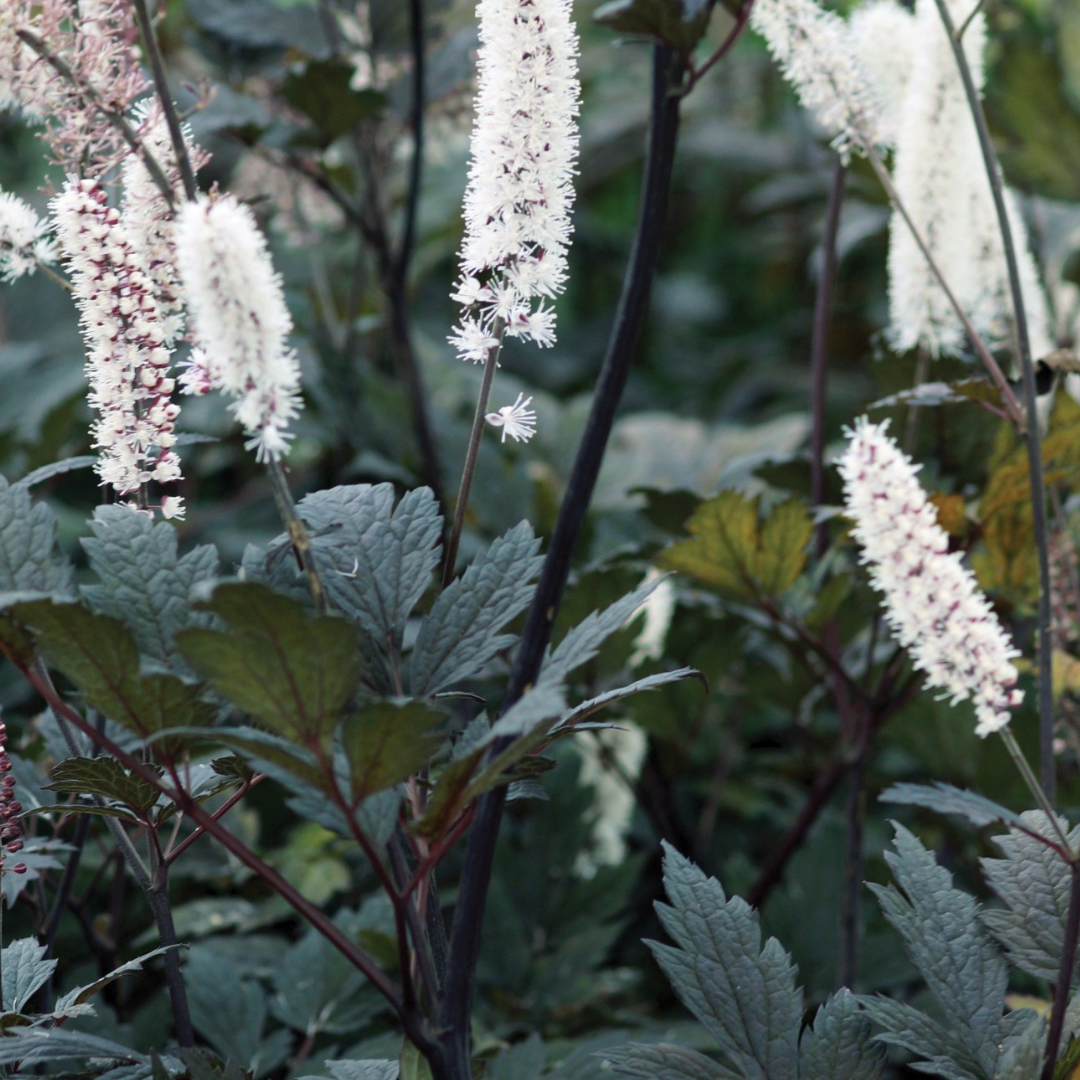
Cimicifuga 'Brunette'
- In stock, ready for delivery
Cimicifuga 'Brunette': Dark Chocolate Foliage, Fragrant Fall Spires
'Brunette' never needs a root touch-up. Finely cut bronze-purple leaves hold their colour all season, then fragrant off-white spikes show up for a late reveal. NATURAL SHADE, ZERO SALON BILLS.
Plant Characteristics:
- Botanical Name: Actaea simplex (Atropurpurea Group) 'Brunette' (syn. Cimicifuga ramosa 'Brunette')
- Common Name: Bugbane
- Height: 120–150 cm (4–5 ft) in flower
- Spread: 60–90 cm (2–3 ft)
- Flowers: Small, fragrant, off-white flowers in dense bottlebrush spikes up to 20 cm (8 in) long, purple-tinted in bud
- Bloom Time: Late summer to fall (August to October)
- Foliage: Finely divided, bronze-purple leaves that hold their colour through the season
- Features: RHS Award of Garden Merit, rabbit resistant, fragrant
Where to Plant: Use it as a dark backdrop in a shady border, at the edge of a woodland, or as a single specimen where the foliage can be seen up close. The white fall spikes light up a dim corner.
Companion Plants: Give 'Brunette' a moist, shady bed where its dark leaves stand behind silver, blue and lemon. Brunnera 'Sea Heart' opens blue sprays at 30 cm in April and May over silvery leaves. Heuchera 'Lemon Supreme' adds bright lemon foliage at 15 to 20 cm. Hosta 'Blue Angel' brings big blue-grey leaves at 80 to 90 cm. Carex 'Evergold' edges the front with arching cream-striped blades at 30 to 45 cm.
Plant Care: Plant in moist, humus-rich soil in part shade. Morning sun is fine and deepens the leaf colour, but protect it from hot afternoon sun and never let it dry out. Mulch every year to keep the soil cool and damp. Bugbane settles in slowly and takes a few years to reach its full size. Avoid moving it once it's planted. Cut the stems back in late fall or early spring. Division is seldom needed. All parts of the plant are toxic if eaten.
History: 'Brunette' is a garden-raised selection of Actaea simplex, a woodland perennial native to eastern Asia from Russia to Japan. It has since become a parent in its own right, as 'Chocoholic' was raised from its seed in the Netherlands.
Final Thoughts: Deer and rabbits don't bother it, and pollinators line up for the late feast. Plant it in shade and LET THE COLOUR SPEAK FOR ITSELF.