

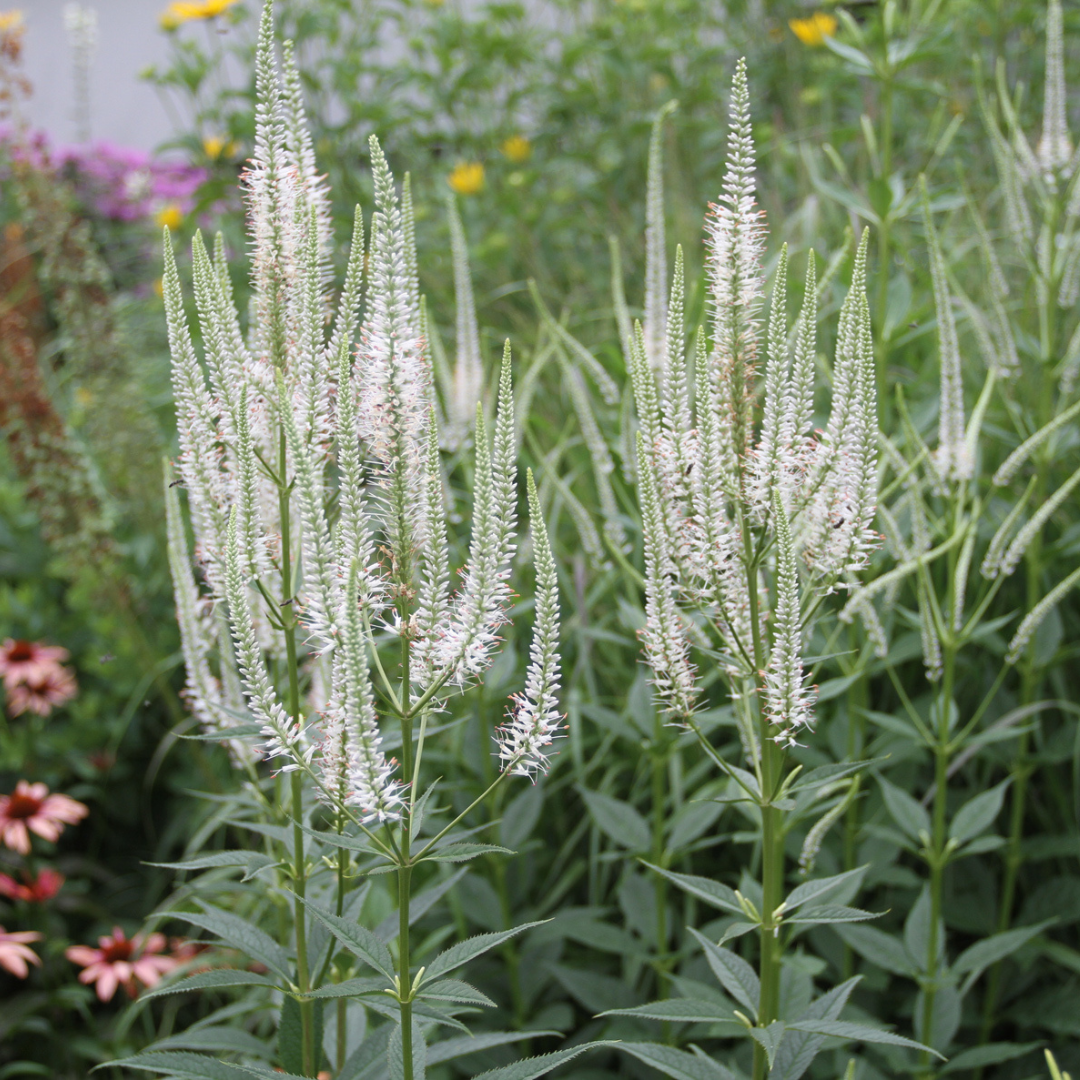
Veronicastrum virginicum
- In stock, ready for delivery
Veronicastrum virginicum: Slim White Spires Standing at Attention
Culver's root branches its white spikes like a candelabra at a fancy dinner party. Tall stems, leaves stacked in tidy tiers, and every pollinator in town has already RSVP'd. NATIVE AND BLACK TIE.
Plant Characteristics:
- Botanical Name: Veronicastrum virginicum
- Common Name: Culver's Root
- Height: 120–180 cm (4–6 ft)
- Spread: 60–90 cm (2–3 ft)
- Flowers: Tiny white tubular flowers, occasionally pale pink, packed into slender spikes up to about 25 cm (10 in) long that branch like a candelabra
- Bloom Time: Midsummer to late summer (July to August)
- Foliage: Narrow, pointed, dark green leaves arranged in tiered whorls up the stem
- Features: Rabbit resistant, good cut flower
Where to Plant: Use it at the back of a border, in a prairie or meadow planting, or in a rain garden, where it handles occasional wet feet. The vertical spikes give height without bulk, so it looks best in groups of three or more.
Companion Plants: Plant Culver's root at the back of a moist, sunny or part-shade native bed with marsh marigolds and blue lobelia. Caltha palustris opens golden marsh marigolds at 30 to 45 cm in April and May. Lobelia siphilitica adds blue lobelia spikes at 60 to 90 cm from July to September. Hibiscus 'Starry Starry Night' brings speckled pale pink blooms at 105 to 120 cm from July to September. Deschampsia cespitosa adds fine blades and airy flower clouds at 60 to 90 cm.
Plant Care: Plant in full sun or light shade in average to moist, humus-rich soil. It tolerates clay. Water regularly through its first season and during long dry spells, since it doesn't like to dry out completely. Young plants take a couple of seasons to reach full height. In very rich soil or too much shade, stems may lean, so give it sun and don't overfeed. Leave the seed heads standing for winter interest and cut the stems down in early spring. Divide large clumps in early spring if needed, though it's happy left alone for years.
History: Veronicastrum virginicum is native to eastern North America, from the Atlantic states west to the prairies and north into southeastern Canada. The common name is traditionally said to honour an 18th-century doctor named Culver, who used the bitter root as a purgative, though that story isn't well documented.
Final Thoughts: Deer and rabbits keep off, and cut stems make a dramatic bouquet. Put it at the back. THE HEAD TABLE IS SET.