

Sanguisorba 'Tanna'
- In stock, ready for delivery
Sanguisorba 'Tanna': Dark Little Buttons on Wiry Stems
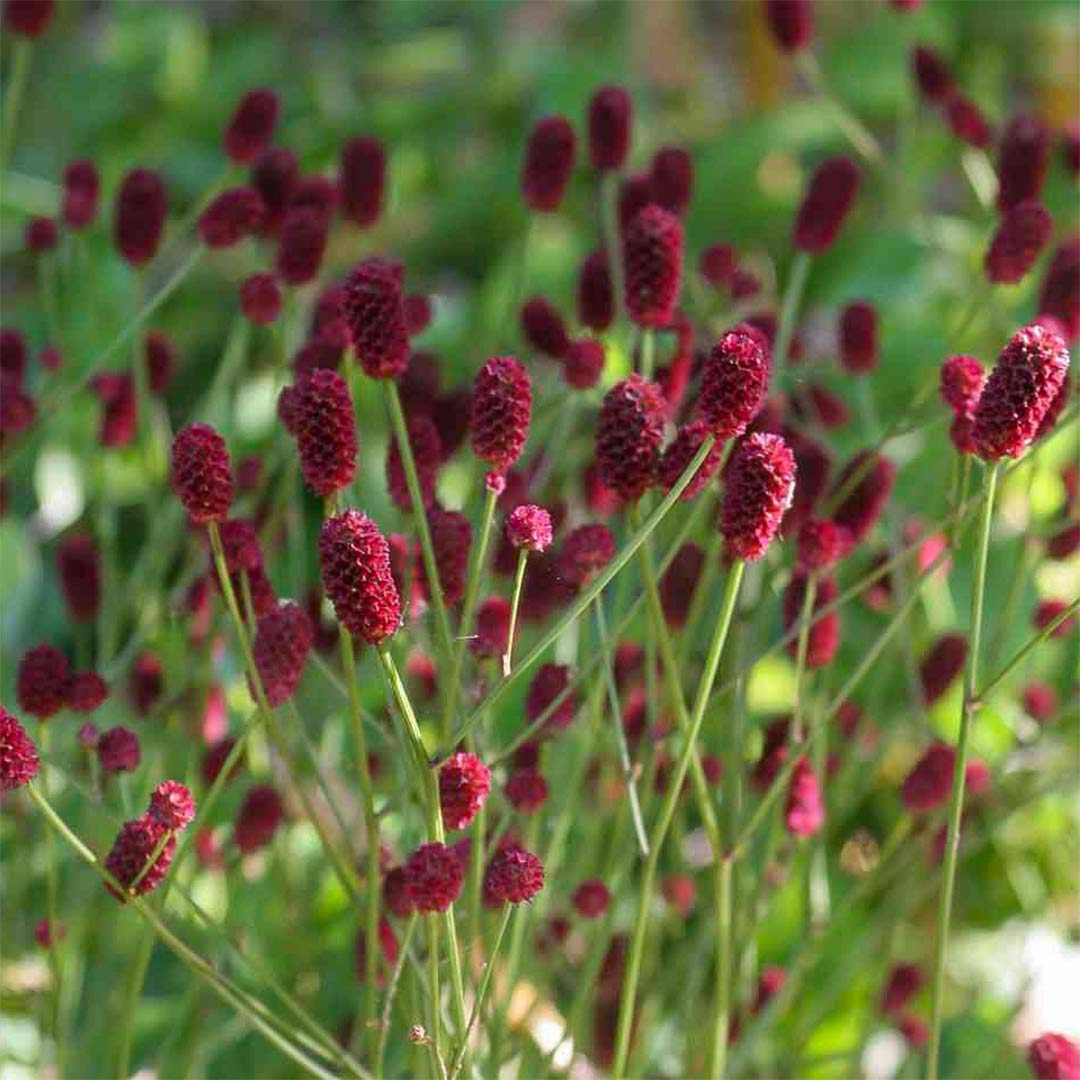
'Tanna' is what happens when a wine cork learns to fly. Burgundy-red little heads bob on slender stems over blue-green leaves, like the garden is toasting itself. TOAST OF THE BORDER.
Plant Characteristics:
- Botanical Name: Sanguisorba officinalis 'Tanna'
- Common Name: Great Burnet
- Height: 30–60 cm (1–2 ft) in flower
- Spread: 30–60 cm (1–2 ft)
- Flowers: Small, deep burgundy-red, cylindrical heads on slender, branching stems
- Bloom Time: Midsummer to early fall (July to September)
- Foliage: Blue-green, crimped leaves finely divided into oblong leaflets
- Features: Compact size, long bloom season, good for cutting
Where to Plant: Its modest size makes it easy to fit into a small garden, the front of a border or a large container. Plant it in groups of three or more so the dark flower heads read as a haze of colour, and snip a few stems for small arrangements.
Companion Plants: Give 'Tanna' a moist bed in sun or part shade with dark heuchera, umbrella plant and fireweed. Heuchera FYRE WING™ 'Jet' edges the front at 18 cm with dark foliage. Darmera peltata opens pale pink flower clusters at 90 to 120 cm in April and May, then huge round leaves. Epilobium angustifolium brings rosy magenta fireweed at 120 to 150 cm from June to August. Deschampsia 'Goldschleier' fills in with fine blades and golden flower clouds at 60 to 90 cm.
Plant Care: Give it full sun or light part shade and moist but well-drained soil. It handles clay, loam or sand, and acidic to alkaline conditions, as long as the soil doesn't dry out for long. Water well through the first season and during summer droughts. Skip heavy feeding, which can make the stems lean. Cut the flowering stems back in late fall, or leave them for winter interest and tidy them in early spring. Divide the clump in spring every few years if the centre thins out or flowering drops off.
History: Great burnet grows wild in damp meadows across much of Europe and temperate Asia, and it belongs to the rose family, with a long history as a medicinal herb. Gardeners have since embraced it for its long-lasting, button-like flowers.
Final Thoughts: Compact enough for a small bed, fancy enough for a vase. The bees keep coming back for refills. POUR ONE OUT. THEN PLANT THREE.