

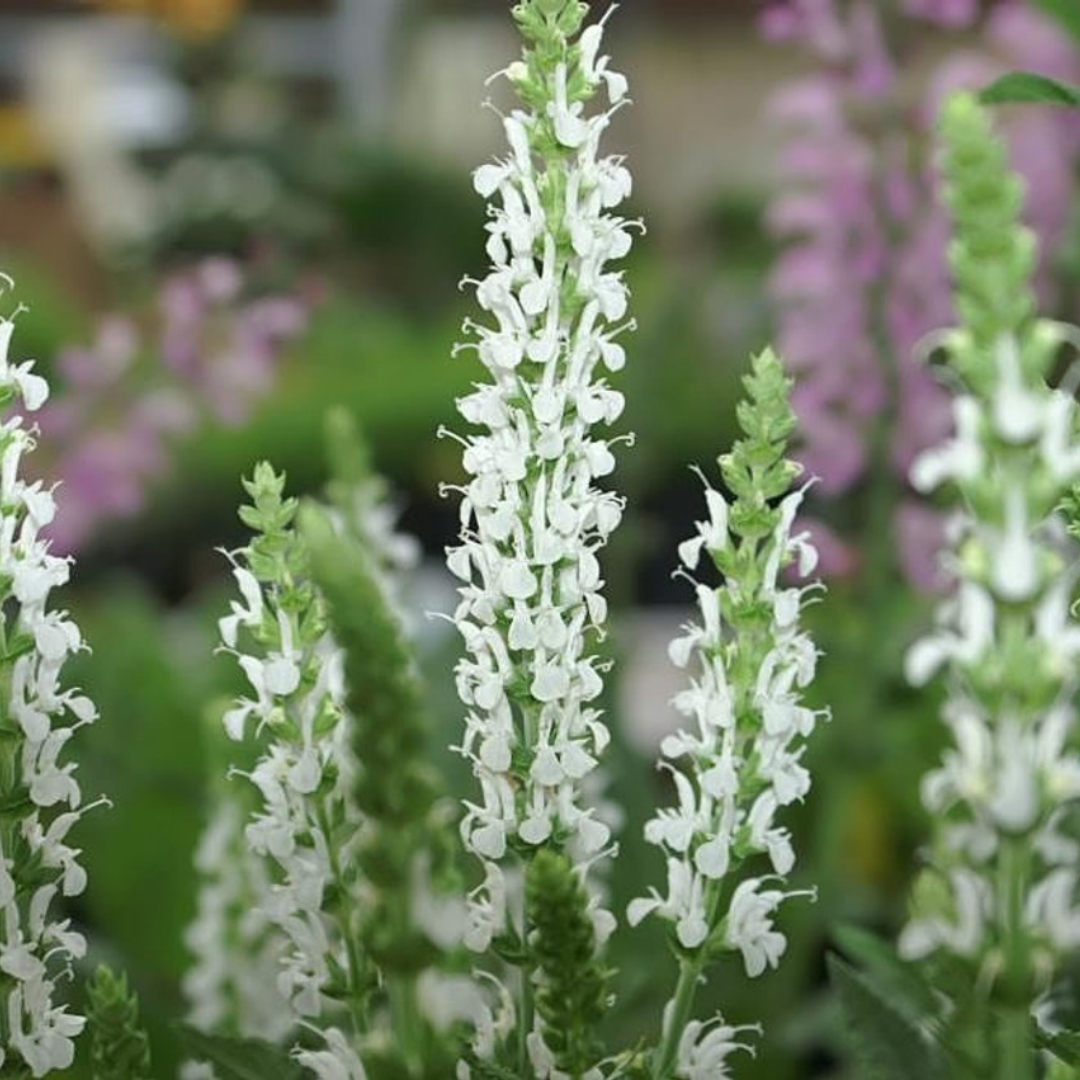
Salvia 'Snow Hill'
- In stock, ready for delivery
Salvia 'Snow Hill': White Spikes as Colour Peacekeepers
'Snow Hill' is the crisp white shirt of the perennial border. Clean, upright spikes that go with absolutely everything, and somehow it never gets a mustard stain. EFFORTLESS. ANNOYINGLY SO.
Plant Characteristics:
- Botanical Name: Salvia × sylvestris 'Schneehügel'
- Common Name: Meadow Sage
- Height: 40–45 cm (16–18 in)
- Spread: 30–40 cm (12–16 in)
- Flowers: Pure white, on short upright spikes with small green bracts
- Bloom Time: Early summer to late summer (June to August), with rebloom when cut back
- Foliage: Green to grey-green, aromatic, in a compact clump
- Features: RHS Award of Garden Merit, long blooming, good cut flower
Where to Plant: Use it to light up the front of a sunny border, cool down hot reds and oranges or anchor a white garden that glows at dusk. It's also handy for separating plants whose colours argue.
Companion Plants: Use white 'Snow Hill' in a sunny, dry bed with white sedum, maroon iris and bronze-eyed coreopsis. Sedum 'Larinem Park' carpets the front at 8 to 15 cm with white flowers in May and June. Coreopsis UpTick™ Gold & Bronze adds gold daisies with a bronze eye at 30 to 36 cm from June to September. Iris 'Sultan's Palace' opens velvety maroon-red Siberian iris at 75 to 85 cm in June and July. Panicum 'Blood Brothers' stands behind at 120 to 150 cm with red-tipped blades.
Plant Care: Plant in full sun in average to lean, well-drained soil. Water through its first season. Once established it handles dry spells. Avoid sites that stay wet in winter. Remove spent flower spikes to stretch the bloom season. When the main flush is done, cut the stems back to the leafy base for a second round in late summer. Cut the clump down in late fall or early spring. Divide in spring every few years if it opens up in the centre.
History: 'Schneehügel', German for “snow hill,” is a Salvia × sylvestris, a hybrid of woodland sage and meadow clary, both native to Europe. It is credited to German nurseryman Ernst Pagels as a white form of his blue 'Blauhügel', and it has earned the Royal Horticultural Society's Award of Garden Merit.
Final Thoughts: Cut a handful for the table and pretend you hired a florist. The bees won't tell. PLANT IT AND PLAY IT COOL.