

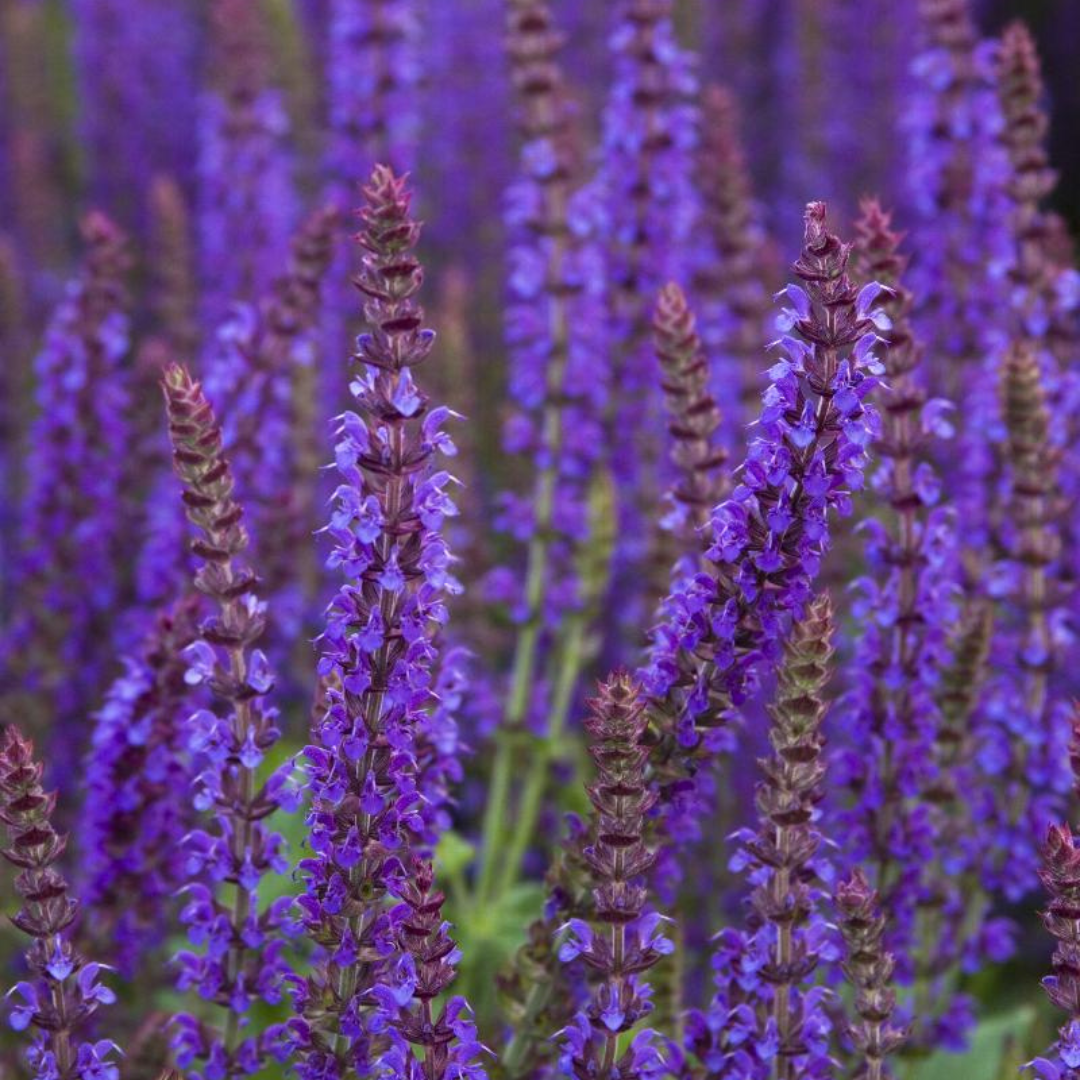
Salvia 'East Friesland'
- In stock, ready for delivery
Salvia 'East Friesland': Old-School Violet, Never Out of Style
Deep violet-purple spikes packed so densely that the bees practically form a line outside. 'East Friesland' is the old reliable that's been carrying sunny borders for ages. THE VETERAN STILL HAS IT.
Plant Characteristics:
- Botanical Name: Salvia nemorosa 'Ostfriesland'
- Common Name: Meadow Sage
- Height: About 45 cm (18 in)
- Spread: About 35 cm (14 in)
- Flowers: Deep violet-purple, on dense upright spikes with pink-tinted bracts
- Bloom Time: Early to midsummer (June to July), with rebloom when cut back
- Foliage: Dark green, slightly wrinkled and aromatic
- Features: Holds the RHS Award of Garden Merit
Where to Plant: Plant it along the front or middle of a sunny border, edge a path with it or mass it for a solid band of colour. The upright spikes give structure to softer, rounder plantings, and it's a strong pick for pollinator gardens.
Companion Plants: Plant 'East Friesland' in a sunny, dry bed with white thrift, crimson iris and red poppies. Armeria 'Alba' edges the front with white pompoms at 15 to 20 cm in May and June. Papaver 'Brilliant' opens fiery red poppies at 60 to 80 cm in May and June. Iris 'Play with Fire' adds ruffled crimson bearded iris at 90 cm in June. Panicum virgatum rises behind at 90 to 150 cm in flower, a native switchgrass.
Plant Care: Give it full sun and average, well-drained soil. It dislikes wet feet in winter, so loosen heavy clay with compost or plant it on a slight rise. Water regularly through the first season. After that it handles dry spells well. When the first wave of flowers fades, shear the stems back to the leafy base. Fresh growth and a second, lighter round of flowers usually follow. Cut the clump back in late fall or early spring. Divide in spring every few years if the centre starts to open up.
History: 'Ostfriesland' was released in 1955 by Ernst Pagels, a perennial nurseryman in Leer, in the East Friesland region of northwestern Germany, who raised it from a packet of sage seed given to him by Karl Foerster. It has since earned the Royal Horticultural Society's Award of Garden Merit.
Final Thoughts: Deer resistant and drought tolerant. Shear it after blooming and it fires right back. EXPERIENCE BEATS HYPE EVERY TIME.