

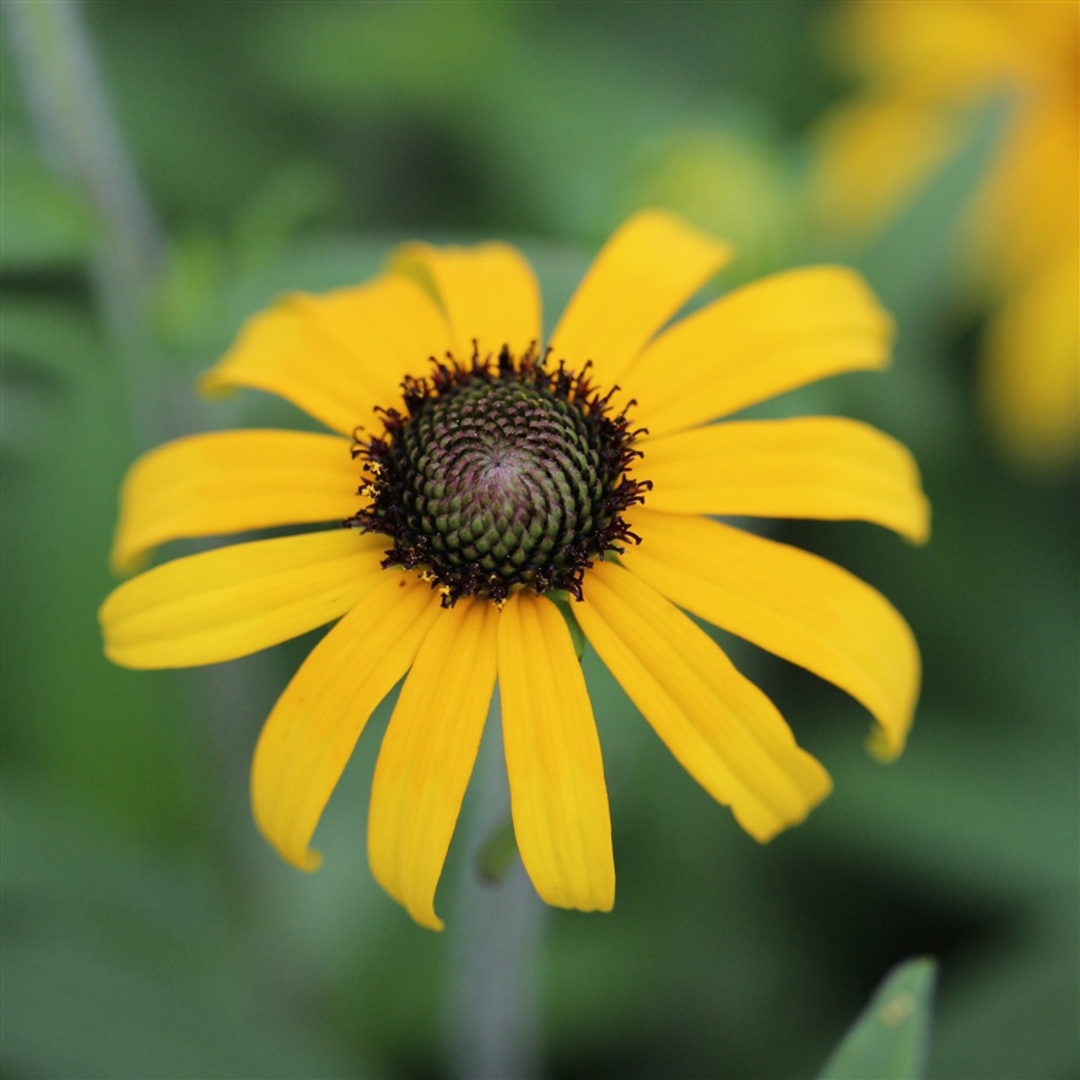
Rudbeckia 'American Gold Rush'
- In stock, ready for delivery
Rudbeckia 'American Gold Rush': Golden Blooms Without the Leaf Spots
Golden daisies with dark chocolate cones, piling on so thick it looks like somebody struck it rich in the flower bed. 'American Gold Rush' is THE ONLY GET-RICH-QUICK SCHEME THAT WORKS.
Plant Characteristics:
- Botanical Name: Rudbeckia hybrid
- Common Name: Black-eyed Susan
- Height: 56–66 cm (22–26 in)
- Spread: 100–110 cm (40–44 in)
- Flowers: Golden-yellow daisies about 7.5 cm (3 in) across, with gently arching petals and dark chocolate-brown cones
- Bloom Time: Midsummer to fall (July to October)
- Foliage: Narrow, fine-haired green leaves with a slightly silvery cast, resistant to Septoria leaf spot
- Features: Seed heads feed songbirds, heat tolerant, tolerates clay
Where to Plant: Its broad, mounded shape is great for massing in sunny borders, meadow-style plantings and pollinator gardens. Plant it in drifts along a walkway or at the front-to-middle of a bed, where its wide habit can fill space, and don't worry about clay or soil pH.
Companion Plants: Plant 'American Gold Rush' in a sunny or part-shade bed with coral geum, a yellow peony and scarlet bee balm. Geum TEMPO™ 'Coral' edges the front with coral-red flowers at 18 to 30 cm from April to June. Paeonia 'Claire de Lune' opens pale yellow single peonies at 70 to 90 cm in May and June. Monarda 'Gardenview Scarlet' adds scarlet bee balm at 90 to 120 cm from July to September. Calamagrostis 'Karl Foerster' rises behind at 120 to 180 cm with upright plumes.
Plant Care: Plant in full sun to part sun, in average, well-drained soil. Very rich soil can make the stems flop, so skip the extra fertilizer. Water regularly through the first season, then only during long dry spells. Leave the seed heads standing in fall. Goldfinches will thank you, and they add winter interest. Cut the plant back in late winter or early spring. Divide every few years in spring to keep the clump vigorous.
History: 'American Gold Rush' was bred by Brent Horvath of Intrinsic Perennial Gardens in Hebron, Illinois, from open-pollinated seed of Rudbeckia fulgida var. deamii, a black-eyed Susan native to the American Midwest. It was a 2020 All-America Selections winner and the Perennial Plant Association's 2023 Perennial Plant of the Year.
Final Thoughts: It shrugs off leaf spot, feeds the songbirds and keeps blooming into fall. Deer pass. STAKE YOUR CLAIM NOW.