

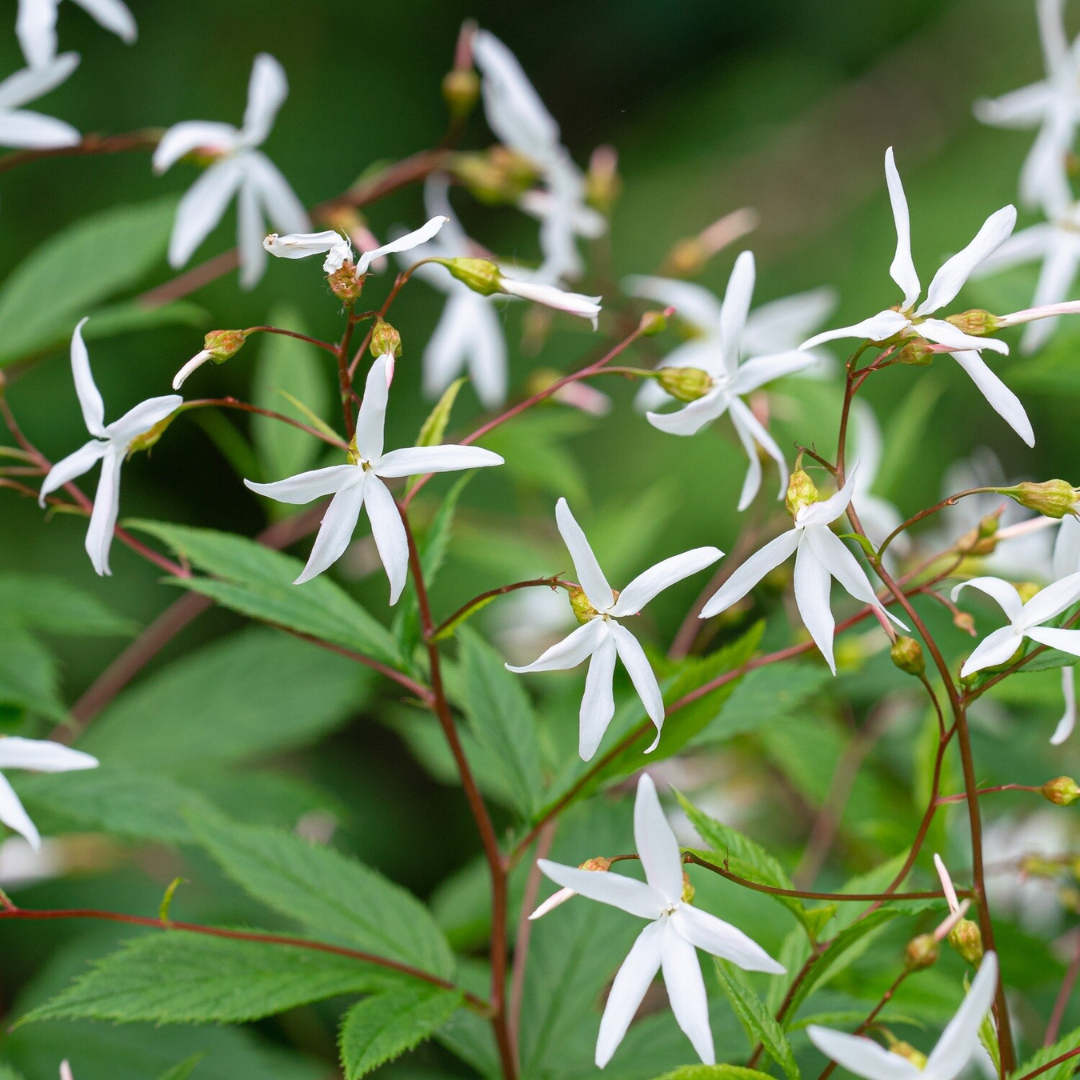
Gillenia trifoliata
- In stock, ready for delivery
Gillenia trifoliata: Airy White Stars With Wine-Red Legs
Bowman's Root is a native with a secret identity. Airy white stars on reddish stems, then a fall makeover in red, burgundy and gold that nobody saw coming. MILD-MANNERED BY DAY. SHOWSTOPPER BY FALL.
Plant Characteristics:
- Botanical Name: Gillenia trifoliata (syn. Porteranthus trifoliatus)
- Common Name: Bowman's Root, also called Indian Physic or American Ipecac
- Height: 60–120 cm (2–4 ft)
- Spread: 45–90 cm (1.5–3 ft)
- Flowers: Small, white, sometimes pink-tinged stars with five narrow petals. Red calyces stay on after the petals drop.
- Bloom Time: Late spring to early summer (June to July)
- Foliage: Three-parted, finely toothed leaves on reddish stems, turning red to burgundy or gold in fall
- Features: Few pest or disease problems
Where to Plant: Bowman's root is a natural for woodland edges, part-shade borders and native plantings, where its loose, shrubby shape and fine texture soften bolder leaves around it. Use it as an airy filler or plant a few together for a drift of white; it also tolerates clay.
Companion Plants: Give Bowman's root a moist bed in sun or part shade where its starry white flowers float over violets. Viola sororia opens purple-blue violets at 15 to 25 cm from April to June. Heuchera FYRE WING™ 'Jadeite' adds bright foliage at 15 to 25 cm with white bells in May and June. Epilobium angustifolium brings rosy magenta fireweed at 120 to 150 cm from June to August. Molinia 'Moorflamme' adds a fine clump at about 60 cm that turns orange-red in fall.
Plant Care: Plant it in moist, well-drained soil with some organic matter. Slightly acidic soil is ideal, but it adapts. In full sun, keep the soil from drying out; in hotter, exposed spots, part shade is kinder. It takes a season or two to settle in, then gets better every year. The stems are thin and wiry, so plants in rich soil or deep shade may lean. A neighbour to lean on usually solves that. Cut stems back in late fall, or leave them for winter interest and cut them in early spring. It rarely needs dividing, and the deep roots prefer to be left alone.
History: Gillenia trifoliata grows wild in dry to moist upland woods and on rocky banks from southern Ontario south to Georgia and west to Kentucky and Arkansas. Indigenous peoples dried and powdered the root for use as an emetic and laxative, which is where the names Indian physic and American ipecac come from.
Final Thoughts: Plant it where you'll catch it from the window. Pollinators visit, pests mostly don't. THE QUIET ONE ALWAYS HAS A PLOT.