

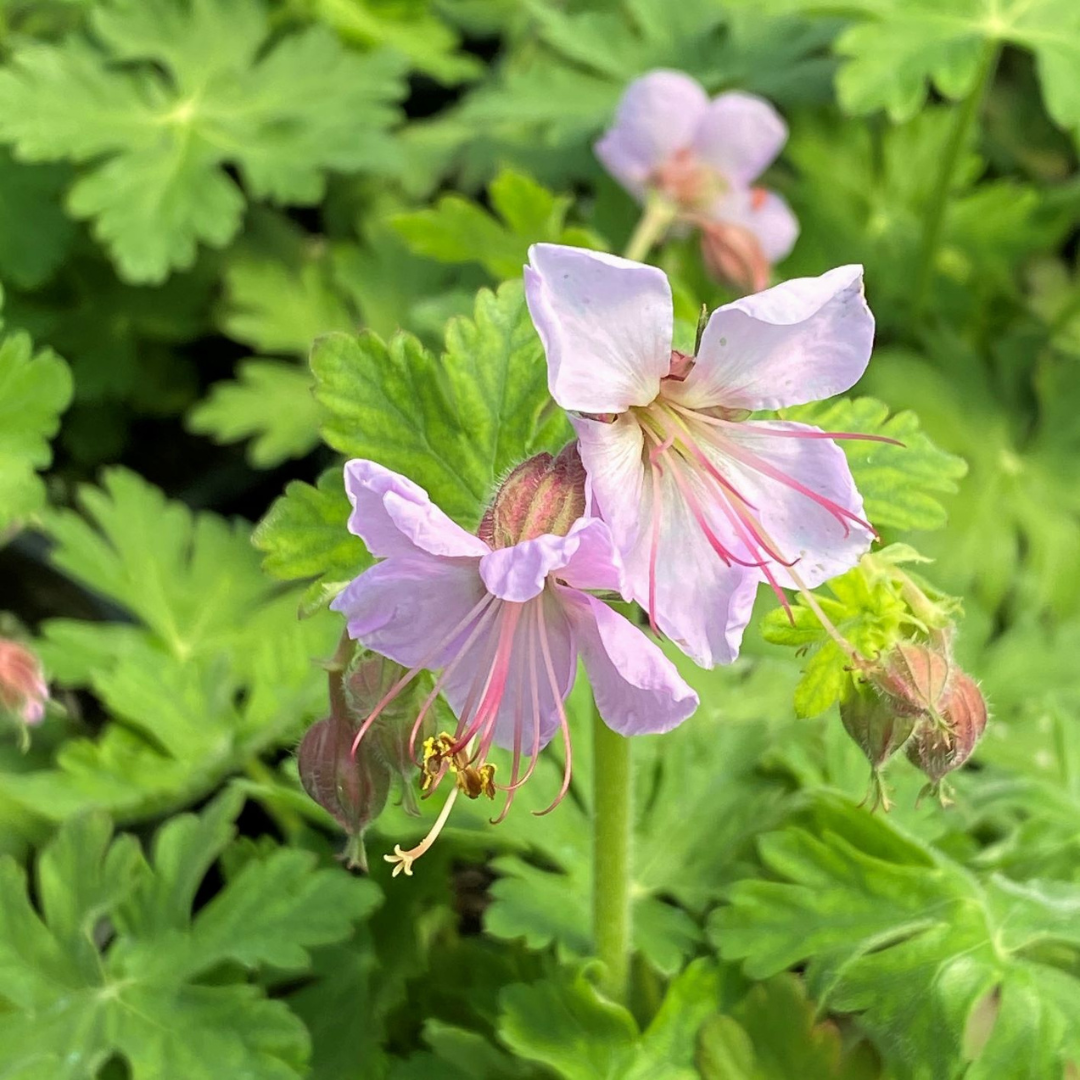
Geranium macrorrhizum 'Ingwersen's Variety'
- In stock, ready for delivery
Geranium macrorrhizum 'Ingwersen's Variety': Soft Pink Carpet for Dry Shade
Pale pink flowers, light green leaves and a scent that hits when you brush past. 'Ingwersen's Variety' is soft-spoken, but put it in dry shade and it acts like it just got the corner office. QUIET CONFIDENCE. LOUD RESULTS.
Plant Characteristics:
- Botanical Name: Geranium macrorrhizum 'Ingwersen's Variety'
- Common Name: Big Root Geranium, Bigroot Cranesbill
- Height: 30–45 cm (12–18 in)
- Spread: 45–60 cm (18–24 in)
- Flowers: Pale pink with long, showy stamens, on sturdy stems
- Bloom Time: Late spring to early summer (May to July)
- Foliage: Soft, light green, strongly aromatic leaves that pick up red and bronze tones in fall
- Features: Rabbit resistant, thrives in dry shade, RHS Award of Garden Merit
Where to Plant: Plant it as a ground cover under trees, along shady walks, on banks, or anywhere you need a weed-proof carpet, especially in dry shade where most perennials struggle. It copes with clay as long as the soil isn't waterlogged.
Companion Plants: Plant 'Ingwersen's Variety' as a soft pink, scented carpet in sun or shade with yellow and apricot behind. Geum Tempo™ 'Yellow' opens semi-double yellow flowers at 35 to 50 cm from April to June. Paeonia 'Top Brass' adds ivory and canary bomb peonies at 80 cm in May and June. Hemerocallis 'Awesome Blossom' brings rose to apricot daylilies at 60 cm from July to September. Miscanthus 'Gracillimus' rises behind at 150 to 180 cm with fine, arching blades.
Plant Care: Plant in sun to shade, in average, well-drained soil. In full sun, it appreciates a bit of moisture. In shade, it's happy with less. Water regularly the first season. Once established, it rarely needs extra water. No deadheading is needed. Tidy old or tattered leaves in early spring. Spreading rhizomes are easy to lift and replant in spring or fall, which is the simplest way to fill a large area.
History: Walter Ingwersen, a German-born alpine plant specialist who ran a well-known nursery in Sussex, England, found this form in the Balkans in 1929, and his nursery offered it in its 1930/31 catalogue. It has since earned the Royal Horticultural Society's Award of Garden Merit.
Final Thoughts: Use it where the hose doesn't reach and nothing else survives. The deer and rabbits won't take a meeting with it. PROMOTED ON THE SPOT.