

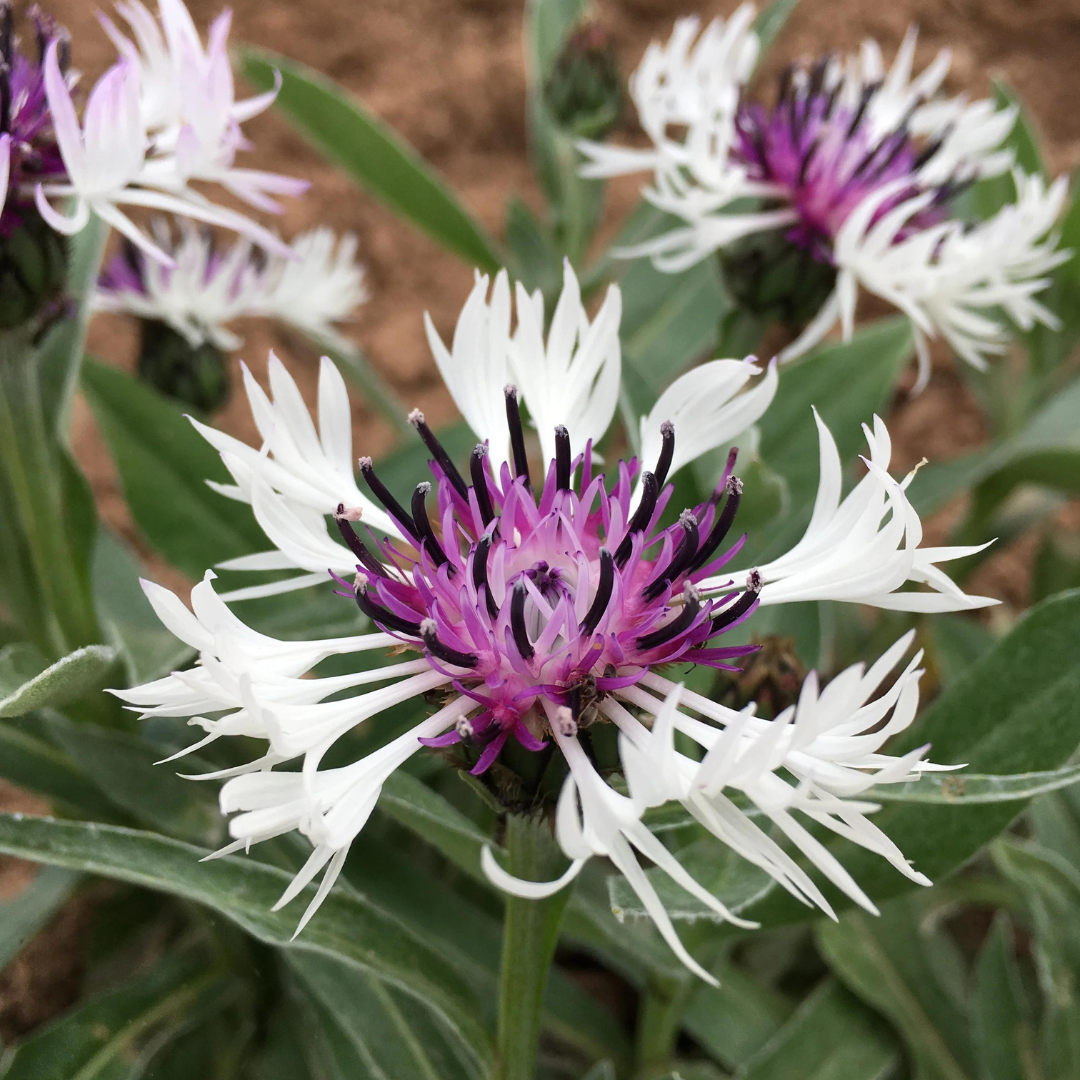
Centaurea 'Amethyst in Snow'
- In stock, ready for delivery
HEADS UP. THIS ONE SPREADS.
Mountain bluet spreads by creeping roots and self-seeds, so it can pop up well beyond where you planted it. Cut it back after the first flush of flowers to cut down on seedlings, and keep it out of woodlands, ravines and other natural areas.
Centaurea 'Amethyst in Snow': Snow-White Petals, Purple Bullseye
White fringed petals around a deep amethyst centre, like a snowflake wearing a gemstone. 'Amethyst in Snow' looks like it belongs in a jewellery store window, not your border. BLING IN THE BORDER.
Plant Characteristics:
- Botanical Name: Centaurea montana 'Amethyst in Snow'
- Common Name: Perennial Cornflower, Mountain Bluet
- Height: 30–40 cm (12–16 in)
- Spread: 30–60 cm (12–24 in)
- Flowers: Fringed white outer petals around a deep amethyst-purple centre, about 5 cm (2 in) across
- Bloom Time: Late spring to midsummer (May to July), with some rebloom after cutting back
- Foliage: Grey-green, softly hairy leaves forming a low mound
- Features: Rabbit resistant, easy to grow
Where to Plant: Use it at the front of a sunny border, along a walkway, in a rock garden or in containers, where people can get close enough to see the two-tone flowers. It also makes a charming small cut flower.
Companion Plants: Give these white and purple cornflowers a sunny, well-drained bed with chartreuse in spring and red in summer. Euphorbia polychroma opens chartreuse-gold bracts at 30 to 45 cm in April and May. Dianthus Fruit Punch® 'Whipped Cream' adds fragrant white pinks at 20 to 25 cm in June and July. Echinacea SunMagic® Vintage Hot Red brings red coneflowers at 45 to 60 cm from July to September. Panicum Prairie Winds® 'Niagara Falls' arches behind at 120 cm with wide, powder-blue blades.
Plant Care: Plant in full sun to part sun in average, well-drained soil. It tolerates sandy and clay soils, but avoid places where water pools in spring. Water well the first season, then only during long dry spells. Deadhead to keep it neat and limit self-seeding. After the main bloom, cut the plant back hard. Fresh foliage follows, often with a few more flowers later in summer. Divide every few years in spring to keep the clump vigorous and tidy.
History: 'Amethyst in Snow' was discovered in May 2002 by Elisabeth Sahin of K. Sahin Zaden in Alphen aan den Rijn, the Netherlands, as a natural mutation of an unnamed Centaurea montana selection with white ray petals and a purple centre.
Final Thoughts: Deer and rabbits ignore it, bees and butterflies don't. Shear it back after flowering for a second round. WINTER WHITE WITHOUT THE WINTER.