

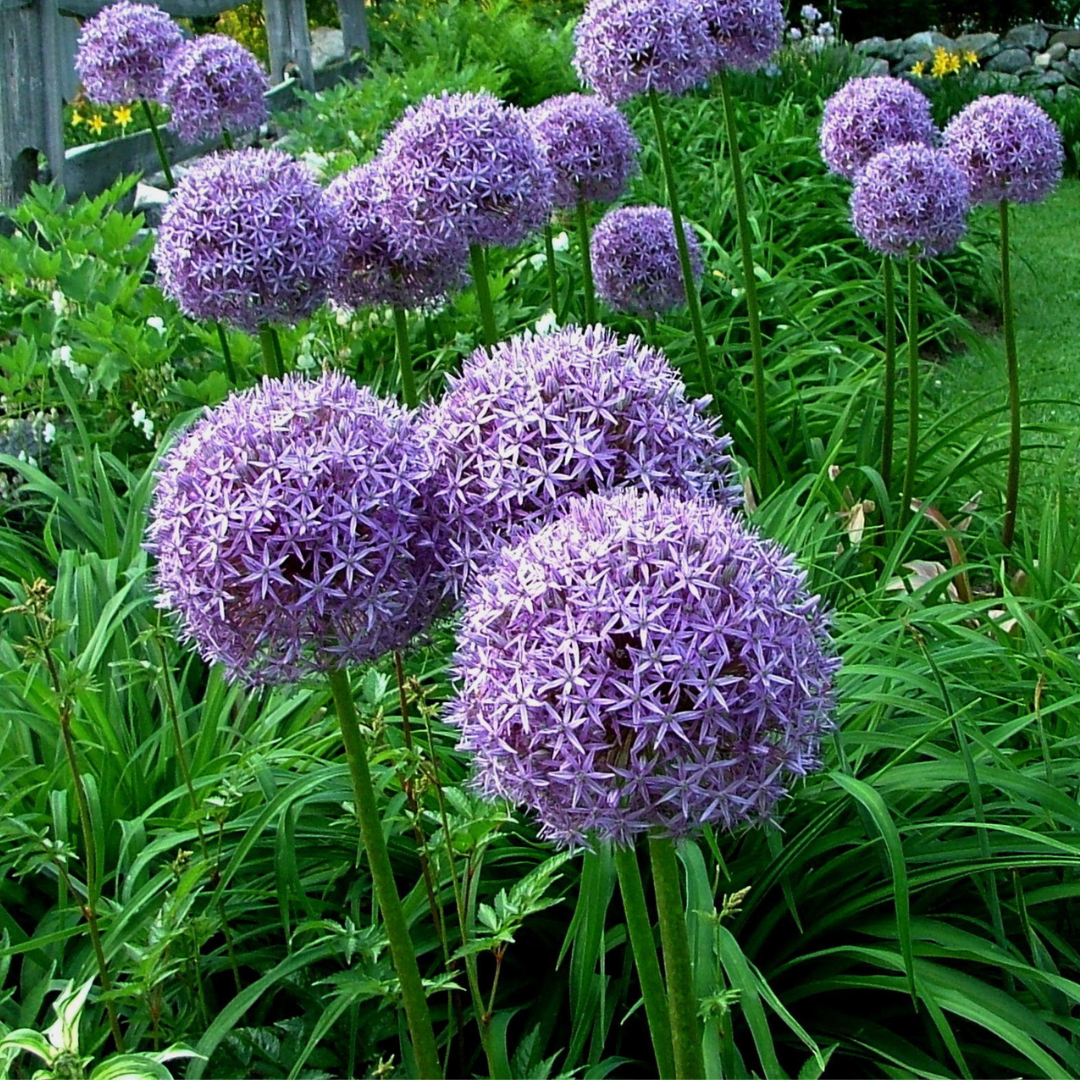
Allium 'Globemaster'
- In stock, ready for delivery
Allium 'Globemaster': Violet Globes, Zero Seedlings
Deep violet spheres packed with starry florets, so big and round they look like they have their own gravity. 'Globemaster' doesn't hold one globe. It holds the WHOLE PLANET'S ATTENTION.
Plant Characteristics:
- Botanical Name: Allium 'Globemaster'
- Common Name: Ornamental Onion
- Height: 60–90 cm (2–3 ft)
- Spread: 30–45 cm (1–1.5 ft)
- Flowers: Deep violet, round heads 15–25 cm (6–10 in) across, packed with star-shaped florets
- Bloom Time: Late spring to early summer (May to June)
- Foliage: Broad, strap-shaped, grey-green basal leaves that fade around bloom time
- Features: Rabbit resistant, long-lasting seed heads, RHS Award of Garden Merit
Where to Plant: Plant it in groups in the middle of a sunny border, or use a single clump as a focal point where you'll walk by often. The heads hold their shape after the colour fades, adding structure into summer. Give it leafy neighbours to hide its yellowing leaves.
Companion Plants: Use these huge violet globes as the May and June show in a sunny, dry border that carries on all summer. Sedum 'Blue Spruce' edges the front at 10 to 25 cm with blue needle leaves and yellow flowers. Echinacea Kismet® 'Yellow' adds butter-yellow coneflowers at 45 cm from June to October. Penstemon 'Dark Towers' brings soft pink tubes on dark stems at 85 to 90 cm from June to August. Panicum 'Prairie Sky' rises behind at 120 to 150 cm with steel-blue blades that turn gold in fall.
Plant Care: Plant in full sun in fertile, well-drained soil. Bulbs rot in wet ground, so amend heavy clay or plant on a gentle slope. Water during spring growth and let the soil dry out more in summer. Allow the leaves to die back on their own after flowering. That's how the bulb stores energy for next year. Leave the dried flower heads for interest, or cut them for arrangements. Divide crowded clumps by lifting and separating offsets in late summer or early fall.
History: 'Globemaster' is a Dutch hybrid between two Central Asian species, Allium cristophii and Allium macleanii, and it rarely sets seed. It holds the Royal Horticultural Society's Award of Garden Merit.
Final Thoughts: The deer and rabbits pass, and even the seed heads look great after bloom. Plant a handful. WORLD DOMINATION, ONE BULB AT A TIME.